Modern JavaScript Best Practices in 2026: A Definitive Guide for Professional Developers

Software Engineer
- #Javaacript
- #Best practise
- #Modern Javascript
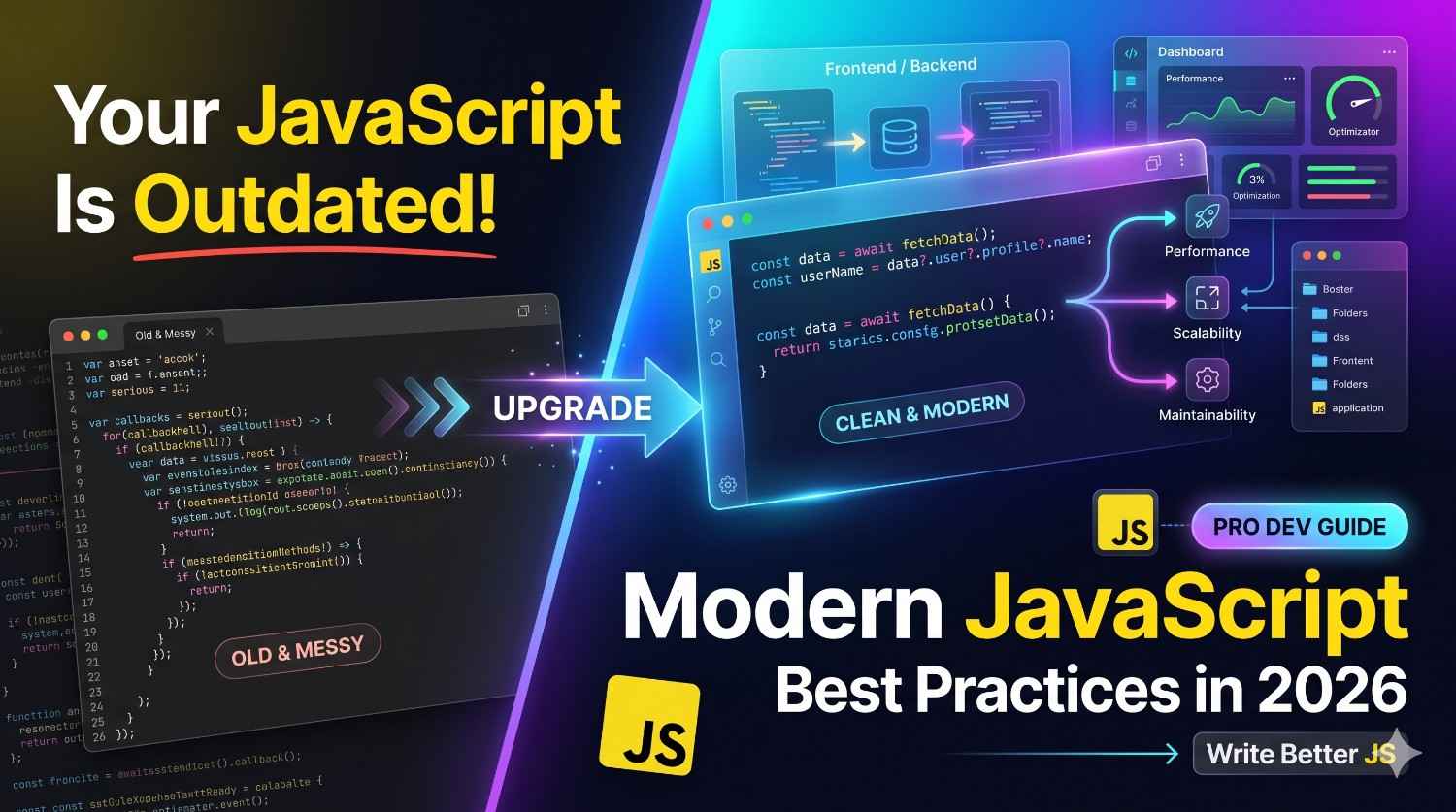
As the JavaScript ecosystem matures, 2026 brings new paradigms focusing on performance, native state management, and type-safe immutable data structures. Stay ahead of the curve with these industry-leading standards.
Modern JavaScript Best Practices in 2026: A Definitive Guide for Professional Developers
JavaScript has evolved far beyond simple browser scripting. In 2026, modern JavaScript powers enterprise SaaS platforms, AI-driven applications, scalable backend systems, real-time collaboration tools, and high-performance frontend experiences.
But here’s the reality many developers discover the hard way: writing JavaScript that works is easy — writing JavaScript that scales is difficult.
If your codebase becomes harder to maintain every month, debugging takes hours, or performance slowly degrades as features grow, chances are you are missing critical JavaScript best practices.
This guide will walk you through the most important JavaScript best practices professional developers follow in 2026 to write cleaner, faster, scalable, and maintainable applications.
Why Modern JavaScript Best Practices Matter
Professional JavaScript development is no longer just about syntax knowledge. Modern engineering teams care about:
Scalability
Performance optimization
Maintainability
Developer experience
Security
Code readability
Reusable architecture
Teams building large applications with React, Next.js, and Node.js rely heavily on clean JavaScript architecture to avoid technical debt.
If you want to improve your engineering mindset beyond syntax, read Thinking Like a Senior Developer.
Use const and let — Avoid var
One of the most fundamental ES2026 JavaScript practices is avoiding var.
Why It Matters
var introduces function-scoped behavior that often causes bugs and unexpected variable overwrites.
Bad Example
        var total = 100;

if (true) {
  var total = 200;
}

console.log(total); // 200
Good Example
        const total = 100;

if (true) {
  const discountedTotal = 200;
}

console.log(total); // 100
Developer Tip
Use
constby defaultUse
letonly when reassignment is necessaryNever use
varin modern production code
Write Cleaner Functions with Arrow Syntax
Arrow functions improve readability and provide cleaner lexical scoping.
Bad Example
        function calculatePrice(price, tax) {
  return price + tax;
}
Modern JavaScript Example
const calculatePrice = (price, tax) => price + tax;Real-World Impact
Cleaner functions become extremely valuable inside React hooks, event handlers, array methods, and async workflows.
Destructuring Improves Readability
Destructuring reduces repetitive object access and keeps code clean.
Without Destructuring
        const user = response.user;

console.log(user.name);
console.log(user.email);
console.log(user.role);
With Destructuring
        const { name, email, role } = response.user;

console.log(name);
console.log(email);
console.log(role);
Why Professionals Prefer It
Cleaner component props
Readable API responses
Better maintainability
Less repetitive code
Optional Chaining and Nullish Coalescing
Modern JavaScript applications frequently deal with incomplete API responses and dynamic data.
Problematic Code
        if (
  user &&
  user.profile &&
  user.profile.address
) {
  console.log(user.profile.address.city);
}
Modern ES2026 Approach
        const city = user?.profile?.address?.city ?? "Unknown";

console.log(city);
Benefits
Cleaner conditional handling
Fewer runtime errors
Safer API integrations
Improved developer productivity
Async/Await Best Practices
Async programming is at the center of professional JavaScript development.
Bad Async Code
        fetchUser()
  .then(user => {
    return fetchPosts(user.id);
  })
  .then(posts => {
    console.log(posts);
  })
  .catch(error => {
    console.error(error);
  });
Modern Async/Await Example
        const getUserPosts = async () => {
  try {
    const user = await fetchUser();
    const posts = await fetchPosts(user.id);

    return posts;
  } catch (error) {
    console.error("Failed to fetch posts", error);
  }
};
Best Practices
Always wrap async code in
try/catchAvoid unnecessary sequential awaits
Use
Promise.all()when tasks can run in parallelNever ignore rejected promises
Parallel Async Optimization
        const [users, posts, comments] = await Promise.all([
  fetchUsers(),
  fetchPosts(),
  fetchComments()
]);
Real-World JavaScript Best Practices
React Applications
In React applications, clean component structure and predictable state management are critical.
Avoid unnecessary re-renders
Memoize expensive operations
Keep components small
Use reusable hooks
Modern React projects often integrate AI-powered workflows. Learn more in Essential AI Toolkit for Developers.
Next.js Applications
Next.js applications require scalable routing, modular architecture, and server/client optimization.
Node.js APIs
Backend JavaScript services must prioritize:
Error handling
Validation
Security
Scalable architecture
Efficient database querying
SaaS Platforms
Large SaaS systems demand clean folder structures and reusable modules.
        src/
├── api/
├── components/
├── hooks/
├── services/
├── utils/
├── middleware/
├── store/
└── features/
Enterprise Frontend Systems
Enterprise systems heavily depend on:
Consistent naming conventions
Type safety
Centralized API handling
Reusable UI components
Performance optimization
Functional Programming Concepts
Functional programming improves predictability and maintainability.
Bad Example
        let total = 0;

for (let i = 0; i < items.length; i++) {
  total += items[i].price;
}
Modern Functional Example
        const total = items.reduce(
  (sum, item) => sum + item.price,
  0
);
Why It Matters
Cleaner transformations
Immutable workflows
Predictable logic
Improved debugging
Immutability Best Practices
Mutating objects directly creates unpredictable bugs.
Bad Example
user.name = "John";Better Approach
        const updatedUser = {
  ...user,
  name: "John"
};
Real-World Impact
Immutable state handling is essential in React, Redux, and real-time collaborative applications.
JavaScript Performance Optimization Tips
Problem Bad Practice Optimized Solution Frequent API calls Direct search requests Debouncing Scroll performance Heavy scroll listeners Throttling Large arrays Nested loops Map/Reduce optimization UI rendering Unnecessary renders Memoization
Debouncing Example
        const debounce = (callback, delay) => {
  let timeout;

  return (...args) => {
    clearTimeout(timeout);

    timeout = setTimeout(() => {
      callback(...args);
    }, delay);
  };
};
Throttling Example
        const throttle = (callback, limit) => {
  let waiting = false;

  return (...args) => {
    if (!waiting) {
      callback(...args);
      waiting = true;

      setTimeout(() => {
        waiting = false;
      }, limit);
    }
  };
};
Security Best Practices in JavaScript
Never expose secrets in frontend code
Use environment variables properly
Validate all API inputs
Sanitize user-generated content
Avoid unsafe dynamic HTML rendering
Use HTTPS everywhere
Environment Variable Example
const apiKey = process.env.API_KEY;Avoid hardcoding sensitive credentials directly inside applications.
Common JavaScript Mistakes Developers Still Make
1. Callback Hell
        login(user, () => {
  getProfile(() => {
    getPosts(() => {
      getComments(() => {});
    });
  });
});
Modern JavaScript should use async/await or promise-based architecture.
2. Overusing Global Variables
Global state creates unpredictable application behavior.
3. Blocking the Event Loop
        while(true) {
  // dangerous infinite loop
}
Blocking the event loop can freeze entire Node.js applications.
4. Mutating Objects Directly
Direct mutations make debugging difficult in large systems.
5. Ignoring Error Handling
Silent failures create production nightmares.
6. Memory Leaks
Unremoved event listeners and uncleared timers slowly degrade performance.
7. Nested Conditional Chaos
        if (user) {
  if (user.isAdmin) {
    if (user.hasPermission) {
      // messy logic
    }
  }
}
Cleaner Alternative
        if (
  user?.isAdmin &&
  user?.hasPermission
) {
  // clean logic
}
Clean Naming Conventions
Bad Naming
        const d = new Date();
const x = users.filter(u => u.a);
Professional Naming
        const currentDate = new Date();

const activeUsers = users.filter(
  user => user.isActive
);
Good naming improves readability more than most developers realize.
Type Safety Concepts in Modern JavaScript
Large-scale JavaScript projects increasingly adopt TypeScript for safer development.
        interface User {
  id: number;
  name: string;
  email: string;
}
Type safety helps prevent runtime bugs and improves IDE support.
Modern JavaScript Developer Checklist
Use
constby defaultAvoid deeply nested logic
Always handle async errors
Write modular code
Use reusable utility functions
Optimize rendering performance
Keep components small
Validate all API inputs
Use environment variables securely
Follow consistent naming conventions
Write readable code first
Prefer immutability
Use linting and formatting tools
Review code regularly
Document complex logic
Recommended Official Resources
How Modern JavaScript Connects with Future Development Trends
JavaScript continues to dominate modern software engineering because it adapts rapidly to evolving technologies.
Today’s developers are increasingly combining JavaScript with:
AI-powered workflows
Edge computing
Serverless platforms
Real-time systems
Distributed architectures
Developers entering the industry should also understand how JavaScript compares with other technologies in the evolving market: Best Programming Languages in 2026.
Key Takeaways
Modern JavaScript is about scalability, not just syntax
Use clean architecture and modular code organization
Async/await improves readability and maintainability
Performance optimization matters in both frontend and backend systems
Immutability reduces unpredictable bugs
Proper error handling is mandatory in production systems
Readable code saves engineering time
Security should always be part of development workflows
Conclusion
The difference between beginner JavaScript developers and professional engineers is rarely syntax knowledge alone. The real difference comes from writing code that remains scalable, readable, maintainable, and performant as projects grow.
Modern JavaScript best practices in 2026 focus heavily on architecture, performance optimization, developer experience, and long-term maintainability.
The best developers are not the ones writing the most complex code — they are the ones writing the clearest, safest, and most scalable systems.
Keep refining your coding standards, review production-grade applications, and continuously improve how you think about software engineering.
FAQs
What are the most important JavaScript best practices in 2026?
The most important practices include using const/let, modular architecture, async/await, proper error handling, immutability, clean naming conventions, and performance optimization.
Why is modern JavaScript focused on scalability?
Modern applications are significantly larger and more complex. Scalable JavaScript architecture helps teams maintain codebases efficiently as products grow.
Should developers still learn vanilla JavaScript deeply?
Absolutely. Strong JavaScript fundamentals are essential for mastering frameworks like React, Next.js, and Node.js.
How can I improve JavaScript performance?
Use debouncing, throttling, lazy loading, memoization, efficient rendering patterns, optimized loops, and proper async handling.
Is TypeScript necessary in 2026?
While not mandatory, TypeScript is increasingly preferred in professional development because it improves maintainability and reduces runtime errors.
What is the biggest mistake JavaScript developers make?
One of the biggest mistakes is writing code without considering long-term maintainability and scalability.