Beyond the Syntax: The Comprehensive Guide to Thinking Like a Senior Developer
April 18, 2026
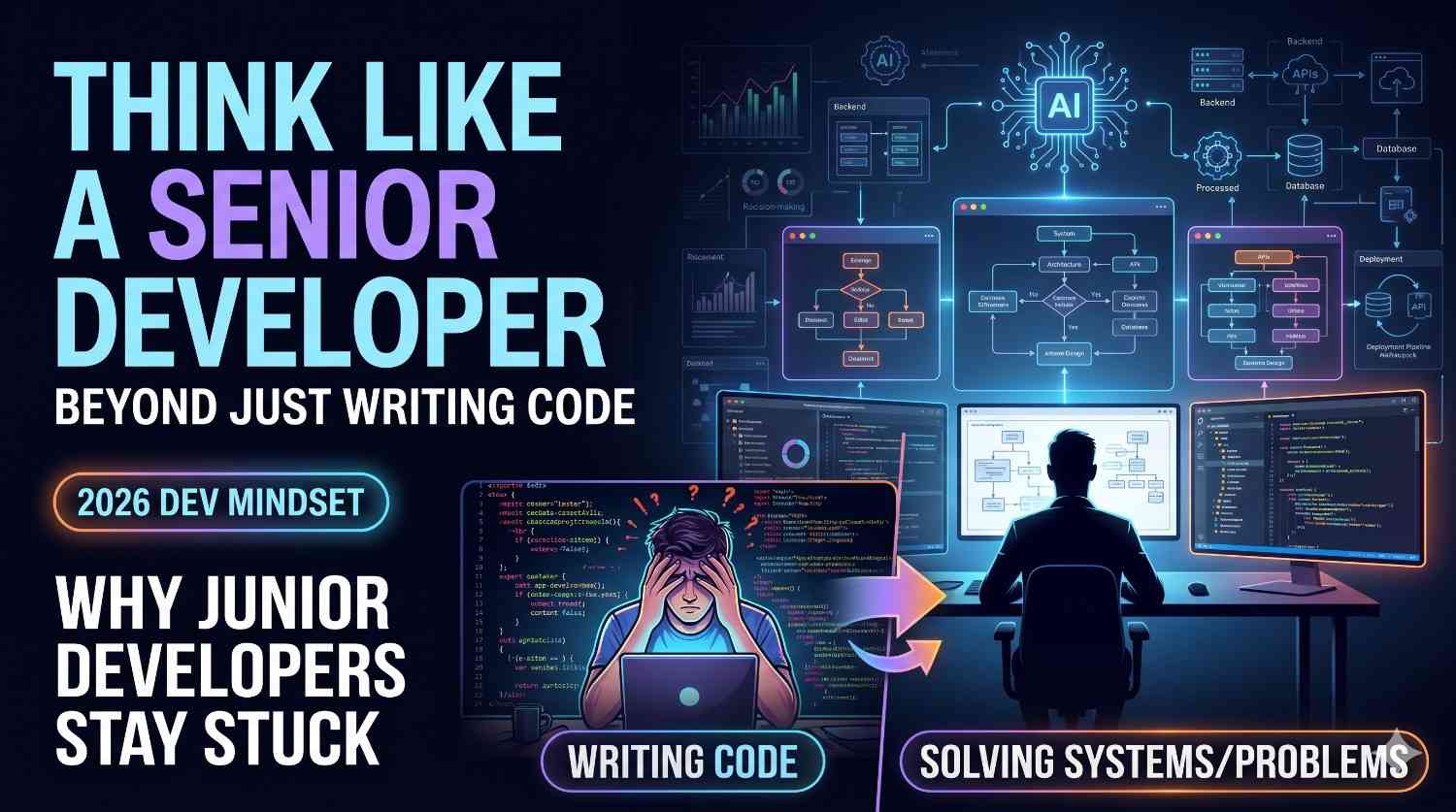
The leap from junior to senior developer is rarely about learning a new framework. It’s about a fundamental shift in perspective—from writing code to solving business problems. Explore the mental models and core competencies required to reach the next level of engineering leadership.
Beyond the Syntax: The Comprehensive Guide to Thinking Like a Senior Developer
Have you ever looked at a senior developer during a production outage and wondered, “How are they staying calm right now?”
While junior developers often focus on writing code that works, senior developers think far beyond syntax. They think about scalability, maintainability, performance, business impact, team collaboration, and long-term consequences.
That’s the real difference.
Thinking like a senior developer is not about memorizing frameworks or knowing every design pattern. It’s about developing a deeper software engineering mindset that helps you solve problems effectively, make better technical decisions, and create systems that survive real-world pressure.
If you feel stuck at the same level despite writing code every day, this guide will help you understand the mindset shifts that separate average developers from senior engineers.
What Actually Separates Junior and Senior Developers?
Many developers think seniority is only about years of experience. But experience alone doesn’t guarantee growth.
A developer can spend five years repeatedly solving the same small problems without improving architectural thinking or engineering judgment.
Junior vs Senior Developer Comparison
Junior Developer Senior Developer Focuses on writing code Focuses on solving business problems Thinks feature by feature Thinks system-wide Optimizes for completion Optimizes for maintainability Needs guidance frequently Takes ownership independently Fixes symptoms Finds root causes Writes code for today Writes code future teams can maintain
The biggest shift happens when developers stop asking: “How do I code this?” and start asking: “What is the best long-term solution?”
Thinking Beyond Syntax
One of the clearest signs of growth is when syntax becomes secondary.
Senior developers don’t obsess over memorizing every method or framework API. They focus on architecture, trade-offs, debugging, scalability, user experience, and system reliability.
They understand that frameworks change, but engineering principles stay relevant.
Questions Senior Developers Ask Constantly
Will this code scale under heavy traffic?
Can another developer understand this quickly?
What happens if this API fails?
How difficult will this be to maintain?
Will this decision create technical debt later?
What business problem are we actually solving?
These questions create a completely different engineering mindset.
Writing Maintainable Code
Beginners often write code that simply works. Senior engineers write code that continues working six months later when requirements change unexpectedly.
Maintainability is one of the most important senior software engineer skills.
Before vs After Example
Messy Code
if(user.role === "admin" || user.role === "manager"){
  if(user.active === true){
    access = true;
  }
}
Cleaner Code
const allowedRoles = ["admin", "manager"];

const hasAccess =
  allowedRoles.includes(user.role) && user.active;
Why This Matters
Easier debugging
Faster onboarding for new developers
Reduced bugs
Improved scalability
Better team collaboration
Common Mistakes Developers Make
Overengineering simple features
Using unclear variable names
Writing giant functions
Ignoring code readability
Copy-pasting logic everywhere
Strong developers actively follow Clean Code Principles because maintainability affects every future feature.
Understanding Business Logic Matters More Than You Think
Junior developers usually focus only on technical implementation. Senior developers understand business goals first.
Imagine an e-commerce company asks:
“Improve checkout speed.”
A junior developer might optimize frontend rendering. A senior developer investigates:
API response times
Database bottlenecks
Third-party payment delays
User drop-off analytics
Infrastructure latency
Senior engineers understand that technical decisions should align with business outcomes.
This shift dramatically improves your value as a developer.
Developing a Scalability Mindset
A feature that works for 100 users may completely fail for 1 million users.
Senior developers constantly think about growth and scalability.
Scalability Thinking Example
Imagine building a chat application.
Junior Thinking
Messages are sending successfully
Frontend updates correctly
Senior Thinking
How many concurrent users can the server handle?
What happens during traffic spikes?
Should messages be cached?
How do we prevent database overload?
What monitoring tools are needed?
This is where concepts like System Design Basics become essential.
Debugging Like a Senior Engineer
Junior developers often panic during bugs. Senior developers slow down and investigate systematically.
Senior Debugging Workflow
Reproduce the issue consistently
Identify affected systems
Check logs and monitoring tools
Isolate the root cause
Verify assumptions carefully
Deploy the safest fix possible
Write preventive improvements
Production Issue Scenario
Imagine your API suddenly becomes slow in production.
Junior Reaction
Restart the server immediately
Guess possible causes randomly
Senior Reaction
Analyze logs first
Check database query performance
Review deployment changes
Inspect infrastructure metrics
Communicate status clearly to stakeholders
Senior developers optimize for controlled decision-making under pressure.
Communication Is a Technical Skill
Many developers underestimate communication. But strong communication is one of the biggest differences between mid-level and senior engineers.
Senior developers explain complex ideas clearly to:
Developers
Clients
Product managers
Designers
Stakeholders
Poor Communication Example
“The backend is broken.”
Better Communication Example
“The API latency increased after the database migration. We identified slow queries and are optimizing indexes now.”
Clarity builds trust.
Senior developers communicate progress, risks, and trade-offs effectively.
Architecture Thinking and System Design
Senior developers think about systems as connected components, not isolated files.
They understand APIs, databases, caching layers, authentication systems, infrastructure, and deployment workflows together.
Simple Architecture Thinking Example
User Request
   ↓
Frontend Application
   ↓
API Gateway
   ↓
Backend Service
   ↓
Database + Cache
   ↓
Response to User
When developers understand the entire flow, debugging and optimization become easier.
Learning How APIs Work and backend architecture helps developers move beyond frontend-only thinking.
Performance Optimization Mindset
Senior developers know performance problems usually appear slowly, then suddenly become critical.
Frontend Performance Example
A junior developer might render huge datasets directly on screen.
A senior developer considers:
Pagination
Virtual scrolling
Memoization
Code splitting
Bundle optimization
Backend Performance Example
Senior backend developers think about:
Database indexing
Query optimization
Caching strategies
Rate limiting
Horizontal scaling
Performance optimization is not only technical — it directly affects user experience and business revenue.
Balancing Perfection vs Shipping Fast
One of the hardest engineering lessons is understanding when code is “good enough.”
Junior developers sometimes chase perfect architectures endlessly. Senior developers understand business deadlines and priorities.
Senior Engineering Trade-Off Thinking
Situation Senior Developer Approach Urgent business deadline Ship stable MVP quickly Core infrastructure feature Prioritize scalability and testing Temporary experiment Avoid overengineering Long-term platform feature Invest in maintainability
Senior engineers understand that every technical decision involves trade-offs.
Handling Technical Debt Responsibly
Technical debt is unavoidable in real-world projects.
The difference is that senior developers manage it intentionally instead of ignoring it.
Signs of Dangerous Technical Debt
Repeated bugs in the same area
Fear of touching old code
Huge deployment risks
Slow feature development
Massive duplicated logic
Practical Improvement Tips
Refactor gradually
Add tests before modifying risky code
Improve documentation
Remove dead code regularly
Review architecture periodically
Real-World Senior Developer Scenarios
1. Frontend Production Crash
A React application crashes after deployment.
A senior frontend developer:
Checks deployment logs
Uses monitoring tools
Rolls back safely if necessary
Communicates with stakeholders
Writes preventive tests afterward
2. Backend API Scaling Problem
Traffic suddenly increases during a product launch.
A senior backend engineer investigates:
Database bottlenecks
API caching opportunities
Infrastructure scaling
Slow external services
Query optimization
3. Database Performance Issues
A query starts taking 15 seconds in production.
Senior developers review:
Indexes
Execution plans
Data growth patterns
Caching strategies
Connection pooling
4. DevOps Deployment Failures
A CI/CD pipeline suddenly fails.
Senior engineers avoid random fixes and analyze:
Environment variables
Infrastructure changes
Docker configurations
Build logs
Dependency conflicts
5. Difficult Code Reviews
Senior developers don’t review code to show superiority.
They focus on:
Maintainability
Security risks
Performance implications
Readability
Long-term scalability
Signs You're Thinking Like a Senior Developer
You think about long-term maintainability
You prioritize business impact over technical ego
You debug calmly under pressure
You communicate clearly with teams
You understand trade-offs
You mentor other developers naturally
You focus on systems instead of isolated code
You take ownership without waiting for instructions
You consider scalability early
You actively reduce technical debt
Senior Developer Mindset Checklist
Write readable code every day
Understand business requirements deeply
Review your own code critically
Think about scalability before deployment
Improve debugging skills continuously
Practice communication regularly
Study system design consistently
Learn from production issues
Read high-quality engineering blogs
Keep improving incrementally
Official Engineering Resources
Continuous Learning Never Stops
One of the most important lessons senior engineers learn is that software engineering constantly evolves.
Great developers stay curious.
They study:
Architecture patterns
Performance optimization
Security best practices
Cloud infrastructure
Database internals
Distributed systems
DevOps workflows
Continuous improvement creates long-term career growth.
Even senior engineers remain students forever.
Key Takeaways
Senior developers focus on solving problems, not just writing code
Maintainability and scalability matter more than clever syntax
Business understanding improves technical decisions
Communication is a critical engineering skill
Debugging requires calm and systematic thinking
Architecture thinking separates experienced engineers from beginners
Technical debt should be managed intentionally
Continuous learning is essential for long-term growth
Conclusion
Becoming a senior developer is not about collecting years blindly.
It’s about developing judgment, ownership, communication, architectural thinking, and problem-solving maturity.
The developers who grow fastest are not always the smartest coders. They are the ones who consistently improve how they think.
Start reviewing your decisions more deeply. Think beyond the current feature. Understand systems. Learn business context. Communicate clearly. Study failures carefully.
Little by little, your mindset changes.
And eventually, you stop thinking like someone who simply writes code — and start thinking like an engineer who builds reliable systems.
FAQs
How long does it take to think like a senior developer?
It varies for every developer. Some developers develop strong engineering judgment within a few years, while others take longer depending on project exposure, ownership, and continuous learning.
Do senior developers still Google basic things?
Absolutely. Senior developers don’t memorize everything. They focus on understanding concepts, architecture, and decision-making.
What is the biggest mindset shift for becoming senior?
The biggest shift is moving from feature-focused thinking to system-wide and business-focused thinking.
Are communication skills really important for developers?
Yes. Clear communication improves collaboration, reduces confusion, and builds trust within engineering teams and with stakeholders.
Should junior developers learn system design?
Yes. Even basic system design knowledge helps developers understand scalability, architecture, APIs, and backend workflows better.
What should developers practice daily to improve faster?
Write maintainable code, review architecture decisions, debug thoughtfully, study production systems, and continuously learn from experienced engineers.
Related Articles
View all posts →Google Fitbit Air: The Ultimate Guide to the Next-Generation Minimalist Fitness Tracker
Discover the Google Fitbit Air, a minimalist fitness tracker designed for screen-free health monitoring. Explore its features, ecosystem, and integration guides.
How Blinkit Scales to Handle Millions of Orders: Quick Commerce Architecture
Discover how Blinkit's cutting-edge quick commerce architecture scales to handle millions of orders under 10 minutes. Read on to master their microservices, queuing, and real-time database strategies.
How a Load Balancer Algorithm Works Behind the Scenes
An in-depth look into the mechanics of load balancers. Explore how static and dynamic algorithms route network traffic to ensure high availability and prevent server downtime.