AI Agents for Developers: Revolutionizing the SDLC through Autonomous Automation

Software Engineer
- #ai-agents
- #artificial-intelligence
- #software-development
- #sdlc
- #devops
- #ai-automation
- #software-engineering
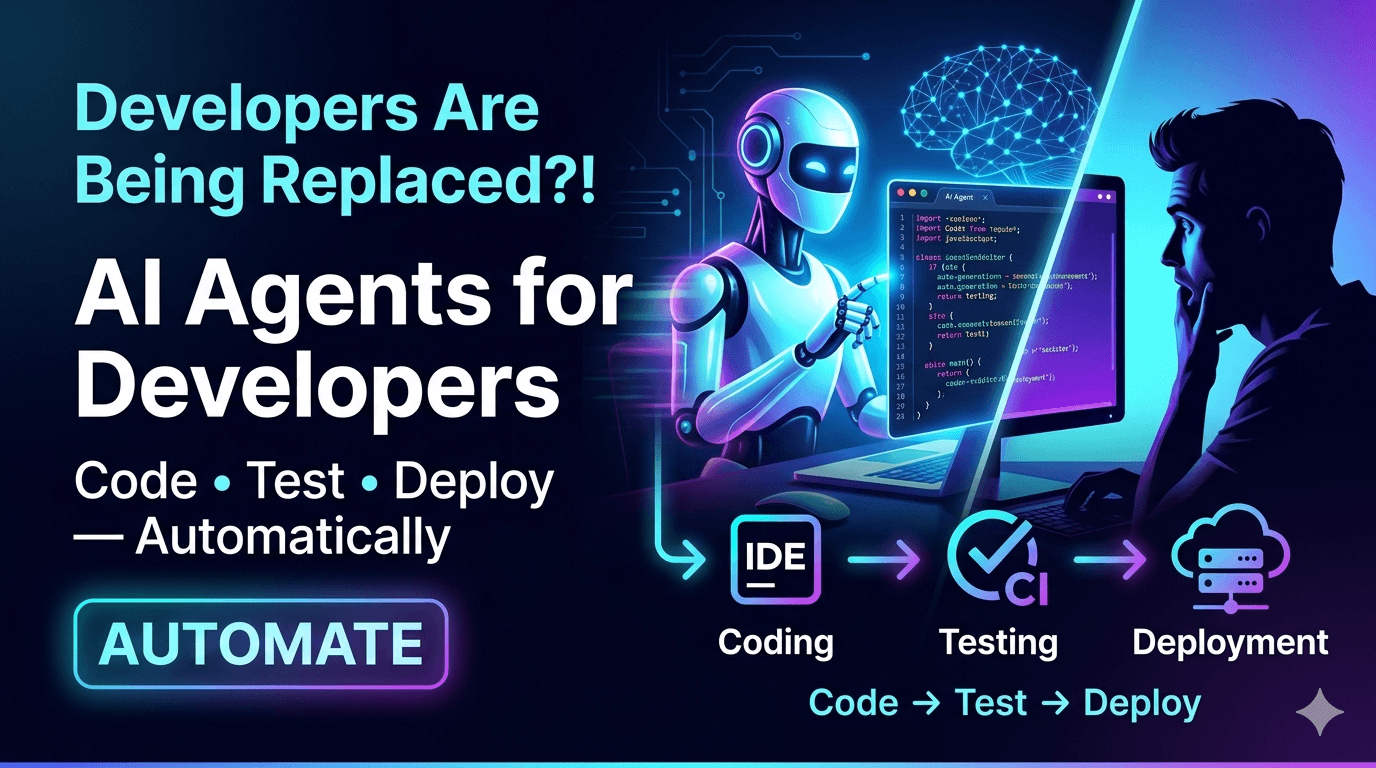
The shift from AI assistance to AI autonomy is here. Learn how AI agents are transforming the software development lifecycle by handling complex coding tasks, autonomous testing, and seamless deployment workflows.
How AI Agents Are Revolutionizing Software Engineering
AI agents are autonomous software systems capable of planning, executing, and self-correcting complex programming tasks across the software development lifecycle (SDLC). By driving the general optimization of engineering workflows, these agents shift developers from manual line-by-line coding to high-level strategic orchestration, completely redefining software production velocity.
For the past few years, developers have grown accustomed to "Copilots"—AI tools that suggest the next line of code or provide helpful snippets. However, the industry is undergoing a paradigm shift as we enter the era of autonomous AI Agents. Unlike passive assistants that require constant, step-by-step instruction, AI agents are proactive, stateful entities capable of deep reasoning, planning, and executing complex, multi-step tasks. According to research by Gartner [1], agentic workflows represent the next major wave of digital transformation, significantly reducing manual developer overhead, minimizing technical debt, and accelerating time-to-market.
By leveraging advanced reasoning frameworks, vector databases for context preservation, and interactive sandbox environments, these agents execute software tasks with unprecedented autonomy. This transition is not merely a superficial improvement; it represents a fundamental overhaul and a general optimization of the traditional software engineering paradigm.
1. Autonomous Coding and Feature Development
Autonomous coding is the capability of AI agents to ingest high-level user requirements, translate them into actionable technical plans, and systematically modify an existing codebase to implement new features. This self-contained development loop eliminates manual execution bottlenecks and accelerates structural refactoring.
Traditional AI autocomplete tools require constant human prompting and immediate oversight. In contrast, an AI agent can accept a high-level requirement—such as "Build a secure password reset flow with email verification and rate limiting"—and execute the entire process independently. They operate inside an agentic loop, typically employing advanced cognitive frameworks like ReAct (Reasoning and Acting) to dynamically plan, execute commands, and adjust their actions based on system feedback. This iterative process includes several key elements:
- File System Navigation and Code Analysis: Agents autonomously read, analyze, and map existing project structures to construct an accurate mental model of codebase dependencies, ensuring new code strictly adheres to established architectural patterns.
- Dependency Management: Automatically identifying, installing, and configuring necessary third-party libraries while actively resolving package version conflicts and security vulnerabilities.
- Refactoring and Modernization: Identifying structural technical debt and systematically applying clean code principles, such as SOLID design patterns, across multiple files to achieve a cleaner codebase and facilitate the general optimization of execution performance.
The Anatomy of the Agentic Coding Loop
To operate effectively, autonomous coding tools construct a directed acyclic graph (DAG) of the tasks required to satisfy a user prompt. They utilize Abstract Syntax Tree (AST) parsers to trace functions, variables, and module exports across the target repository. When faced with an error, such as a compilation failure or a failing unit test, the agent interprets the compiler output, traces the bug back to its source, and applies a targeted fix. This feedback-driven execution is what separates true agents from static generative models.
By leveraging tools like OpenDevin, Swe-agent, or AutoGPT, modern developers can transition from writing boilerplate code to acting as strategic orchestrators, overseeing the development process while the agent handles logic implementation, error handling, and local environment validation.
2. Redefining Quality Assurance with Self-Healing Tests
Self-healing testing refers to the capacity of AI agents to automatically detect broken test suites caused by UI or backend modifications and dynamically rewrite the underlying test scripts to align with the updated application state. This automated resilience dramatically lowers the cost of quality assurance and reduces CI/CD friction.
Testing is historically one of the most neglected phases of the software development lifecycle due to its repetitive nature and the high upkeep cost of brittle test environments. AI agents transform this bottleneck into a streamlined, automated process. They do not just write test suites; they actively maintain and optimize them over time through continuous runtime analysis and monitoring.
- Autonomous Test Generation: Agents analyze raw codebase changes and code coverage metrics to automatically generate comprehensive unit, integration, and end-to-end (E2E) tests that systematically cover edge cases human testers might overlook.
- Self-Healing Pipelines: When a user interface update breaks a functional test, an AI agent can instantly identify the structural modification (such as an updated DOM selector, dynamic class names, or modified REST payloads) and autonomously patch the test script.
- Synthetic Data Generation: Creating realistic, structurally valid, and anonymized datasets to conduct extensive stress testing, performance benchmarking, and security vulnerability audits.
The following example demonstrates how an autonomous AI agent can evaluate a finance helper module and generate an automated integration testing suite using modern Javascript tools like Vitest:
// Example: AI Agent generating a Vitest suite based on component logic
import { describe, it, expect } from 'vitest';
import { calculateTax } from './financeEngine';

describe('Finance Engine Logic', () => {
  it('should handle zero-tax jurisdictions correctly', () => {
    const result = calculateTax(100, 0);
    expect(result).toBe(0);
  });

  it('should correctly apply standard tax rates for regular income bracket', () => {
    const result = calculateTax(50000, 0.15);
    expect(result).toBe(7500);
  });

  it('should throw an explicit error when negative income is supplied', () => {
    expect(() => calculateTax(-100, 0.2)).toThrow('Income cannot be negative');
  });
});
By integrating testing agents directly into developer workflows, engineering teams can achieve the general optimization of test coverage [2]. These self-healing pipelines ensure that test suites remain fully updated with zero human intervention, preventing build-breaker issues from stalling deployment queues while maintaining high software reliability.
3. Orchestrating DevOps and Deployment
Autonomous DevOps uses AI agents to manage continuous integration and deployment pipelines, monitor application health, troubleshoot infrastructure anomalies, and automatically scale resources. This bridges the gap between active code creation and production reliability, shifting operational tasks to intelligent automation.
The boundary between development and infrastructure is where AI agents deliver profound operational efficiencies. By integrating deeply with continuous integration and continuous deployment (CI/CD) pipelines, container orchestration engines like Kubernetes, and leading cloud providers, agents act as tireless, digital Site Reliability Engineers (SREs).
When a cloud deployment fails, an AI agent can instantly analyze system logs, correlate the runtime exceptions with recent Git commits, pinpoint the root cause of the crash, and either submit a hotfix or execute an automated rollback. This immediate response mechanism dramatically decreases the Mean Time to Resolution (MTTR) for critical systems.
Infrastructure as Code (IaC) and Resource Allocation
In addition to runtime triage, AI agents manage Infrastructure as Code (IaC) configurations (such as Terraform or Pulumi scripts). By analyzing real-time CPU, memory, and network throughput telemetry, agents can optimize resource allocation. They dynamically scale microservices, adjust auto-scaling groups, and identify redundant or over-provisioned cloud assets. This systemic oversight leads to a highly effective, automated general optimization of organizational cloud spend and performance efficiency [3].
4. The Deep Architectural Framework of AI Agents
The internal architecture of autonomous AI agents relies on three core structural pillars: dynamic planning systems, hierarchical memory layers, and extensive tool integration. This coordinated architecture allows them to go far beyond standard LLMs by maintaining persistent state, reasoning through novel errors, and executing changes in external production systems.
To understand why autonomous agents are far more powerful than basic generative chatbots, we must analyze the key components of their architectural runtime:
- Planning and Reasoning: Agents decompose large, ambiguous objectives into discrete sub-goals. Using cognitive patterns like Tree-of-Thoughts (ToT) and self-reflection loops, they review historical decisions, evaluate intermediate results, and dynamically adjust their strategies.
- Memory Architecture: Agents utilize short-term memory (in-context execution history, terminal outputs, and chat history) paired with long-term memory (vector databases like Pinecone or Milvus storing structural codebase embeddings) to maintain architectural context over extensive horizons.
- Tool Integration: Unlike static models, agents are equipped with secure sandboxed environments containing tools such as bash terminals, compilers, debuggers, git CLI, and web scrapers, enabling them to execute, test, and verify their outputs before asking for review.
Comparing Copilots vs. Fully Autonomous AI Agents
To illustrate how agentic workflows represent a complete evolutionary leap over traditional AI assistants, we can compare their core capabilities across key execution paradigms:
| Execution Vector | AI Copilots (Passive Assistants) | Autonomous AI Agents (Proactive Systems) |
|---|---|---|
| Initiation Mode | Purely reactive. Requires continuous user-prompted trigger inputs. | Proactive. Executes independently based on high-level goal directives. |
| Memory Horizon | Extremely limited. Relies entirely on current open file context. | Highly stateful. Utilizes vector DBs and execution state persistence. |
| Tool Interaction | None. Can only recommend text changes to the code editor. | Full integration. Accesses bash, compilers, git, and web APIs. |
| Execution Loop | Single-turn generation. Relies on human user for error correction. | Multi-turn loops. Self-reflects, runs tests, and heals own bugs. |
| Workflow Scope | Assists in writing individual lines, functions, or blocks. | Manages entire SDLC tasks, from ticket ingestion to live deployment. |
This comparison highlights how the shift to agentic systems drives the general optimization of entire development pipelines, as human engineers transition from writing granular logic to validating architectural behavior and business requirements.
5. The Human-Agent Collaboration Model
The human-agent collaboration model is a modern workflow paradigm where human engineers step back from manual code drafting to focus on system architecture, supervising AI agents through code reviews, constraint definitions, and security policies.
The rapid rise of autonomous engineering agents does not make human software engineers obsolete; instead, it elevates their professional scope to that of high-level system architects, product designers, and strategic gatekeepers. According to empirical studies on developer-AI collaboration [4], teams that adopt robust agentic workflows report a significant surge in development velocity and overall job satisfaction, as software engineers are liberated from repetitive, low-cognitive tasks.
The Human-in-the-Loop (HITL) Validation Framework
In this collaborative paradigm, human engineers establish critical guardrails to prevent agent drift and maintain compliance. Human responsibilities are centered on three foundational pillars:
- Defining Constraints and Guardrails: Specifying strict architectural frameworks, secure coding patterns, scalability requirements, and structural software designs.
- Pull Request Review and Audit: Evaluating agent-generated PRs, examining runtime efficiency, verifying alignment with business goals, and performing final code quality checkouts before merging.
- Threat Modeling and Security Governance: Ensuring that agents operate in secure, isolated sandbox environments and inspecting imported code modules for license compatibility and potential vulnerabilities [5].
This system of checks and balances ensures that the implementation of AI agents results in a clean, secure, and sustainable general optimization of engineering output without sacrificing codebase control or quality standards.
Conclusion
AI agents are no longer a theoretical technology; they are rapidly becoming the operational engine of high-velocity software engineering organizations. By automating the routine aspects of coding, unit testing, dependency handling, and infrastructure orchestration, agents allow engineering teams to focus on creative problem-solving and strategic business architecture.
To maintain a competitive edge in an increasingly automated landscape, engineering leaders and software developers must move beyond basic code generation tools and begin integrating advanced agentic workflows into their daily stacks. The future of software engineering belongs to those who learn to orchestrate autonomous systems with precision, utilizing agents to drive the general optimization of digital product creation from concept to production.