
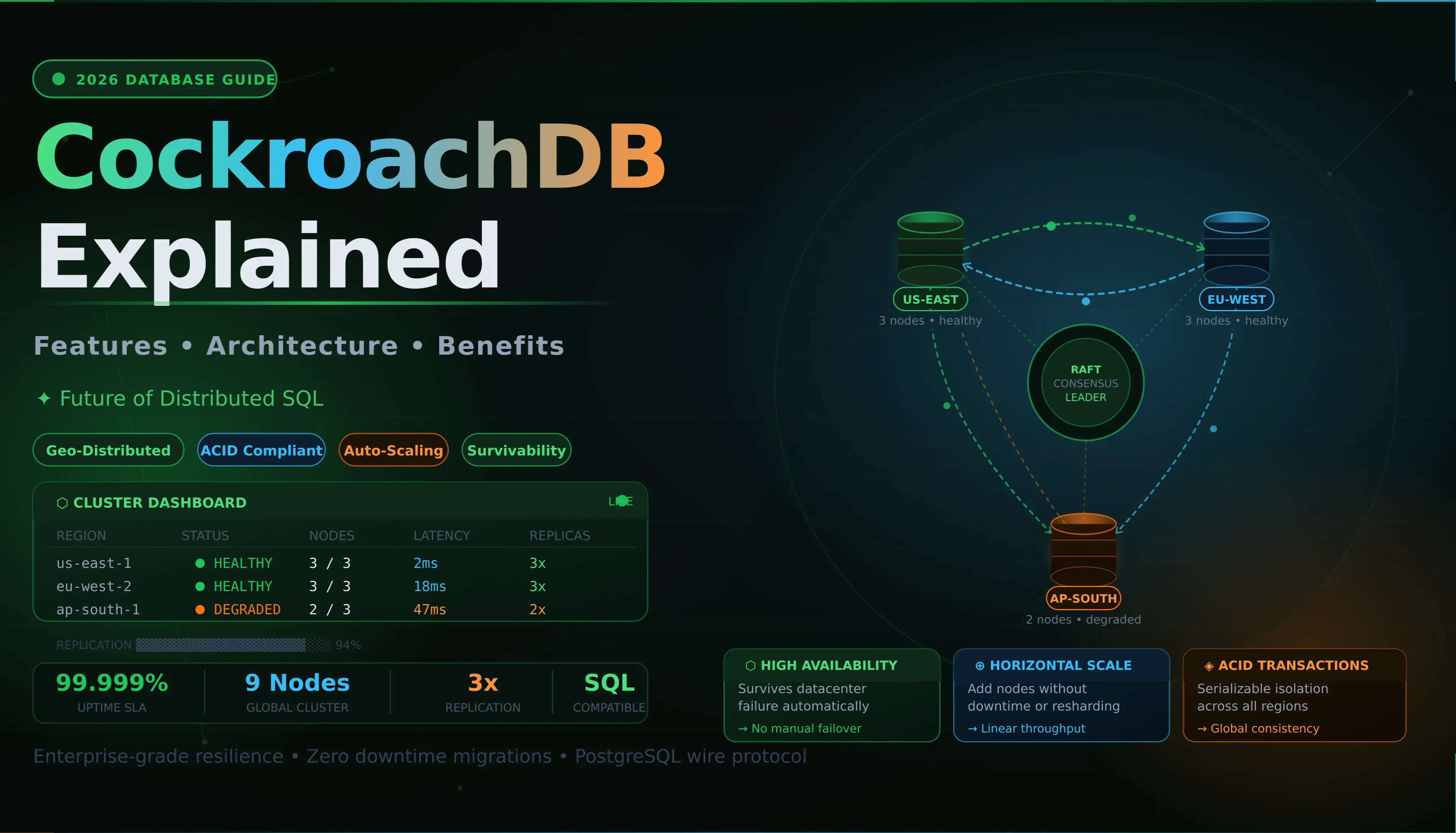
CockroachDB Explained: Features, Architecture, and Benefits in 2026
Modern applications are no longer built for a single city, a single server, or even a single cloud region. Developers today ship AI platforms serving millions of inference requests, SaaS products spanning continents, and fintech systems where downtime directly translates into financial loss.
Traditional relational databases were never designed for this level of global distribution. Scaling PostgreSQL vertically eventually becomes expensive. MySQL replication introduces operational complexity. Failover strategies become fragile under real production pressure.
That’s exactly why CockroachDB has become one of the most discussed distributed SQL databases in 2026. It combines the familiarity of SQL with the resilience of cloud-native distributed systems.
If you're already exploring scalable backend engineering concepts, you'll also enjoy scalable software architecture using SOLID principles , clean code engineering practices , and scalable Node.js backend development .
What Is CockroachDB?
CockroachDB is a distributed SQL database built for cloud-native applications that require high availability, horizontal scaling, and fault tolerance.
Instead of relying on a single primary database server, CockroachDB distributes data across multiple nodes while maintaining strong transactional consistency.
Think of it as:
PostgreSQL-like SQL experience
Kubernetes-native scalability
Automatic replication and failover
Global multi-region architecture
Survivability during infrastructure failures
CockroachDB was originally inspired by Google's Spanner architecture and designed around one core idea:
Databases should survive failures automatically without operational panic.
That philosophy resonates strongly in 2026 where backend systems are expected to stay online continuously, even during node crashes, cloud outages, or regional failures.
Why Distributed SQL Matters in 2026
Backend architecture has fundamentally changed.
AI infrastructure, edge computing, real-time collaboration apps, global SaaS platforms, and multi-region APIs all demand databases capable of scaling horizontally while preserving SQL semantics.
Traditional scaling approaches often look like this:
    Single PostgreSQL Server
        ↓
Vertical Scaling
        ↓
Read Replicas
        ↓
Sharding
        ↓
Operational Complexity Explosion
Distributed SQL systems attempt to solve this by making horizontal scaling a native capability instead of an afterthought.
Why Developers Are Moving Toward Distributed Databases
Global user bases require low-latency regional access
Downtime tolerance is approaching zero
Cloud-native infrastructure expects elasticity
AI workloads generate massive transactional throughput
Microservices create highly distributed data access patterns
Developers working on modern architecture stacks often combine CockroachDB with concepts from AI-powered engineering workflows and scalable Next.js application architecture .
CockroachDB Architecture Explained
The real magic of CockroachDB lies in its distributed systems design.
High-Level Cluster Architecture
    ┌─────────────────────────────────────────────┐
│              CockroachDB Cluster            │
├─────────────────────────────────────────────┤
│                                             │
│   Node 1        Node 2        Node 3        │
│   ┌──────┐      ┌──────┐      ┌──────┐      │
│   │Data A│◄────►│Data A│◄────►│Data A│      │
│   └──────┘      └──────┘      └──────┘      │
│                                             │
│   Automatic Replication + Consensus         │
│                                             │
└─────────────────────────────────────────────┘
Core Components
Nodes
Every node can accept reads and writes.Ranges
Data is automatically split into ranges for scalability.Replication
Data is replicated across multiple nodes automatically.Raft Consensus
CockroachDB uses the Raft protocol to ensure consistency.Distributed Transactions
ACID guarantees remain intact across nodes.
How Automatic Failover Works
    Client Request
      ↓
Leader Replica
      ↓
Replicated to Followers
      ↓
Consensus Achieved
      ↓
Transaction Committed
If a node fails:
Another replica automatically becomes leader
Traffic reroutes transparently
Applications continue operating
No manual failover intervention required
This is one of the reasons CockroachDB is increasingly popular for high availability databases.
How Distributed SQL Works
Distributed SQL combines traditional relational database semantics with distributed systems scalability.
Capability Traditional SQL Distributed SQL ACID Transactions Yes Yes Horizontal Scaling Limited Native Automatic Failover Complex Built-In Multi-Region Support Manual Native Consistency Strong Strong
Unlike NoSQL systems that sacrifice relational consistency, CockroachDB preserves SQL familiarity while distributing data globally.
Key Features of CockroachDB
1. Strong Consistency
CockroachDB guarantees serializable isolation across distributed transactions.
This is critical for:
Banking systems
Inventory management
Financial ledgers
Order processing
2. Horizontal Scaling
Need more capacity? Add nodes.
CockroachDB automatically rebalances data across the cluster.
3. Multi-Region Deployments
    US-East  ◄────► Europe ◄────► Asia
   │             │             │
Low Latency  Local Reads   Regional Writes
Geo-partitioning helps reduce latency for global applications.
4. PostgreSQL Compatibility
CockroachDB supports the PostgreSQL wire protocol, making migrations significantly easier.
5. Automatic Survivability
Node failures, zone outages, and infrastructure disruptions are handled automatically.
6. Cloud-Native Infrastructure
CockroachDB works naturally with:
Kubernetes
Docker
Terraform
Multi-cloud deployments
CI/CD pipelines
CockroachDB vs PostgreSQL vs MySQL
Feature CockroachDB PostgreSQL MySQL Distributed Architecture Native Limited Limited Horizontal Scaling Excellent Manual Manual Automatic Failover Built-In External Tools External Tools Operational Complexity Moderate Low to Moderate Low Global Multi-Region Support Excellent Complex Complex SQL Compatibility PostgreSQL-Compatible Native Native
PostgreSQL remains exceptional for many workloads. In fact, if you're evaluating modern Postgres infrastructure, check out the best PostgreSQL databases for modern developers .
But once systems become globally distributed, CockroachDB's architecture starts offering operational advantages that traditional relational databases struggle to match.
Real-World CockroachDB Use Cases
Globally Distributed SaaS Applications
Imagine a project management platform with users in:
San Francisco
London
Singapore
CockroachDB allows data locality while maintaining global consistency.
Fintech Infrastructure
Financial systems require:
Transactional integrity
Strong consistency
Auditability
Zero data loss tolerance
Distributed SQL is particularly attractive for payment systems and ledger architectures.
AI Platforms
AI infrastructure increasingly requires globally scalable metadata systems.
Examples include:
Model serving metadata
Inference tracking
User personalization systems
Distributed vector indexing workflows
E-Commerce Systems
    Customer Orders
      ↓
Inventory Validation
      ↓
Payment Processing
      ↓
Distributed Transaction
      ↓
Global Order Synchronization
CockroachDB simplifies highly available transactional workflows across regions.
Cloud-Native Startups
Startups benefit because:
No early sharding strategy required
Infrastructure scales incrementally
Operational resilience improves immediately
Future multi-region expansion becomes easier
Scalability and Performance
Scalability is where CockroachDB shines.
Horizontal Scaling Workflow
    Traffic Increase
      ↓
Add New Nodes
      ↓
Automatic Rebalancing
      ↓
Higher Throughput
      ↓
Minimal Downtime
Read Optimization
Follower reads reduce latency
Regional replicas improve locality
Automatic query distribution improves throughput
Latency Trade-Offs
Distributed consistency introduces unavoidable network coordination overhead.
That means:
Cross-region writes can become slower
Consensus protocols add latency
Schema design matters more
This is one of the biggest engineering trade-offs developers must understand.
CockroachDB with Modern Backend Stacks
Node.js Integration
    import { Pool } from "pg";

const pool = new Pool({
  connectionString: process.env.DATABASE_URL
});

async function getUsers() {
  const result = await pool.query(
    "SELECT * FROM users"
  );

  return result.rows;
}
Prisma + CockroachDB Example
    datasource db {
  provider = "cockroachdb"
  url      = env("DATABASE_URL")
}

model User {
  id    String @id @default(uuid())
  email String @unique
}
Docker Deployment
    docker run -d \
  --name=cockroach \
  -p 26257:26257 \
  -p 8080:8080 \
  cockroachdb/cockroach:latest \
  start-single-node --insecure
Kubernetes Deployment
    apiVersion: apps/v1
kind: StatefulSet
metadata:
  name: cockroachdb
Teams building scalable JavaScript systems should also explore:
Security and Reliability
Security Features
TLS encryption
Role-based access control
Encrypted replication traffic
Cloud-native security integrations
Disaster Recovery
CockroachDB supports:
Incremental backups
Point-in-time recovery
Geo-redundant replication
Regional failover
Fault Tolerance Example
    Region Failure
      ↓
Replica Election
      ↓
Traffic Redirected
      ↓
Application Continues Running
Trade-Offs and Limitations
No database architecture is perfect.
1. Distributed Complexity
Distributed systems are inherently harder to reason about than single-node databases.
2. Latency Challenges
Cross-region consistency introduces network overhead.
3. Operational Learning Curve
Teams need stronger infrastructure and observability knowledge.
4. Cost Considerations
Multi-region infrastructure can become expensive at scale.
5. SQL Compatibility Gaps
Although PostgreSQL-compatible, some advanced PostgreSQL features may behave differently.
Common Mistakes Developers Make
Assuming distributed SQL eliminates all scaling problems
Ignoring regional latency design
Poor schema partitioning strategies
Overusing cross-region transactions
Underestimating observability requirements
Skipping load testing
Designing applications without data locality awareness
Strong backend architecture still matters enormously. Databases do not magically fix poor system design.
CockroachDB Best Practices
Design around locality whenever possible
Minimize cross-region write dependencies
Use connection pooling aggressively
Monitor replication latency carefully
Benchmark realistic workloads early
Deploy observability tooling from day one
Automate backups and failover testing
Use Kubernetes operators for orchestration
The Future of Distributed SQL
The rise of AI infrastructure, edge computing, and globally distributed SaaS platforms is accelerating demand for resilient cloud-native databases.
In many ways, CockroachDB represents where backend infrastructure is heading:
Globally distributed by default
Multi-region aware
Self-healing infrastructure
Cloud-native scalability
Operational automation
As applications become increasingly global, the database layer can no longer remain centralized.
The future of backend engineering is not just scalable compute — it’s globally resilient data infrastructure.
Key Takeaways
CockroachDB is a distributed SQL database built for cloud-native systems
It provides horizontal scaling with strong consistency
Automatic failover and replication improve resilience dramatically
Multi-region deployments are a major advantage
PostgreSQL compatibility reduces migration friction
Distributed SQL introduces latency and operational trade-offs
Ideal for SaaS, fintech, AI platforms, and globally distributed systems
Official References and Further Reading
Conclusion
CockroachDB is not simply another SQL database. It represents a broader shift in how backend systems are designed in the cloud-native era.
Modern applications increasingly require:
Global scalability
Continuous availability
Operational resilience
Elastic infrastructure
Strong consistency guarantees
Traditional relational databases still remain incredibly valuable. But distributed SQL systems like CockroachDB are becoming essential for organizations building globally distributed products.
In 2026, scalable backend architecture is no longer just about APIs and containers. It’s about designing data infrastructure that survives growth, failures, and global scale without collapsing under operational complexity.
FAQs
What is CockroachDB used for?
CockroachDB is used for distributed SQL workloads requiring high availability, horizontal scaling, and strong consistency across regions.
Is CockroachDB better than PostgreSQL?
It depends on the workload. PostgreSQL is excellent for many applications, while CockroachDB excels in globally distributed and highly resilient systems.
Does CockroachDB support SQL?
Yes. CockroachDB supports SQL and is largely compatible with PostgreSQL syntax and tooling.
Can CockroachDB scale horizontally?
Yes. Horizontal scaling is one of CockroachDB’s core architectural strengths.
Is CockroachDB good for startups?
Yes. Startups building cloud-native products can benefit from automatic scalability and resilience without implementing manual sharding strategies early.
Does CockroachDB support Kubernetes?
Absolutely. CockroachDB integrates well with Kubernetes and modern cloud-native orchestration workflows.
What are the biggest trade-offs of distributed SQL?
The biggest trade-offs include increased architectural complexity, latency coordination between regions, and more advanced operational requirements.
