AI Agents vs. Agentic AI: Understanding the Shift to True Autonomy
May 25, 2026
- ai agents
- agentic ai
- autonomous agents
- artificial intelligence
- enterprise automation
- ai workflows
- generative ai
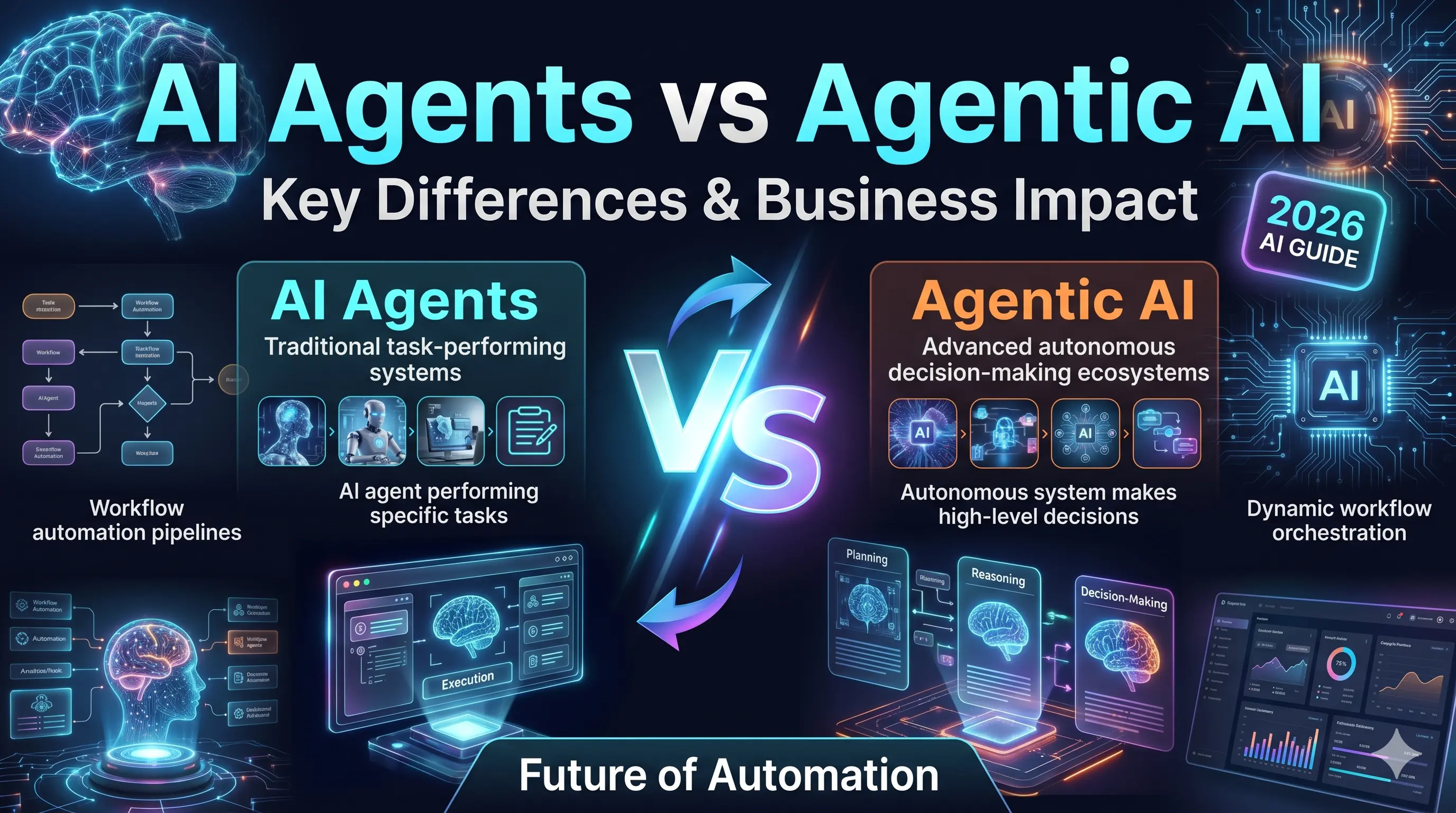
While 'AI agents' and 'Agentic AI' sound nearly identical, they represent distinct concepts in modern enterprise technology. Discover how the shift from discrete agents to agentic workflows is redefining the future of automation.
AI Agent vs Agentic AI: Key Differences, Architecture, and Business Impact in 2026
Artificial intelligence is no longer just a productivity tool sitting quietly in the background. In 2026, AI systems are beginning to make decisions, orchestrate complex workflows, coordinate tools, and execute end-to-end tasks with minimal human intervention. This shift has introduced two terms dominating engineering discussions, startup roadmaps, and enterprise strategy meetings: AI agents and Agentic AI.
If you are exploring the evolution of autonomous software, understanding the distinction between an AI agent vs agentic ai is critical. While an AI agent refers to a single, task-specific autonomous software entity designed to execute narrow goals using tools, agentic AI represents a broader architectural philosophy and system-wide ecosystem where multiple autonomous components, advanced planning, and persistent memory work together to adapt to changing environments dynamically.
They sound similar, and they frequently overlap—but understanding the distinction is becoming increasingly important for software engineers, vibe coders, AI/ML developers, and product builders. It fundamentally impacts how systems are designed, how workflows are automated, and how businesses will compete in the next decade.
If you've recently explored autonomous workflows, orchestration frameworks, or modern AI development stacks, articles like The Essential AI Toolkit, Prompt Engineering for MERN Developers, and Autonomous Agent Workflows have probably hinted at this transition already.
This comprehensive guide breaks down the real differences between AI agents and Agentic AI, explains how they work internally, and explores why businesses are aggressively investing in them to build the next generation of digital infrastructure.
What Are AI Agents?
An AI agent is a specialized software system designed to perform tasks autonomously using reasoning, memory, tools, APIs, and decision-making capabilities. Think of AI agents as specialized digital workers configured to achieve a specific outcome.
Direct Definition: An AI agent is a task-oriented, autonomous system powered by large language models (LLMs) that analyzes context, selects appropriate external tools, and executes actions to achieve specific predefined objectives.
Most modern AI agents are powered by a combination of LLMs, retrieval systems, vector databases, and specialized orchestration frameworks. They receive goals, analyze context, choose actions, execute those actions, and return outcomes to the user.
Key Features of an AI Agent
- Task-Specific Scope: Built to solve a clear, defined problem (e.g., writing a script, answering a support ticket).
- Tool Integration: Capable of using web browsers, executing APIs, and querying vector databases.
- Reactive Execution: Typically triggers in response to a prompt or event, running through its designated loop until the task is complete.
Real-World Examples of AI Agents
To help visualize how these agents operate in production, here is a breakdown of common types, their primary functions, and active use cases:
| AI Agent Type | Primary Function | Example Use Case |
|---|---|---|
| Customer Support Agent | Answers user questions and resolves issues | Automated SaaS customer service ticketing |
| Coding Agent | Generates, reviews, and debugs source code | AI pair programming and automated PR reviews |
| Research Agent | Collects, filters, and summarizes raw web information | Automated competitive intelligence and market analysis |
| DevOps Agent | Monitors system health and applies quick fixes | Cloud infrastructure automation and log monitoring |
| Sales Agent | Qualifies inbound leads and schedules meetings | CRM synchronization and automated email outreach |
What Is Agentic AI?
Agentic AI is a broader AI paradigm where systems demonstrate goal-driven behavior, adaptive planning, multi-step reasoning, and highly autonomous decision-making at scale. Instead of focusing on an isolated agent doing one job, Agentic AI focuses on the entire ecosystem of autonomous intelligence.
Direct Definition: Agentic AI refers to a system-wide class of artificial intelligence capable of independent planning, persistent reasoning, real-world adaptation, and coordinated multi-agent execution across complex, dynamic environments.
Rather than relying on human developers to map out every workflow, Agentic AI systems create their own strategies. They continuously coordinate multiple sub-agents, manage long-term state across sessions, and self-reflect to correct mistakes before final delivery.
Core Elements of Agentic AI Ecosystems
- Multi-Agent Coordination: Different specialized agents communicating and delegating tasks to each other.
- Self-Reflection Loops: The system critiques its own output, runs tests, and adjusts its approach recursively.
- Long-Term Memory and State: Retaining context across long cycles and continuous operational runs.
- Dynamic Goal Adaptation: If an obstacle is encountered, the system reformulates its plan without breaking or requiring a developer reboot.
In simple terms: if AI agents are individual specialized workers, then Agentic AI is the autonomous operating system and organizational culture coordinating them all.
AI Agent vs Agentic AI: The Core Differences Explained
Understanding the distinction between an AI agent vs agentic AI is crucial for modern system design. The comparison below outlines how these two paradigms diverge across critical architectural and operational parameters.
Direct Answer: While an AI agent operates as an isolated, task-based executor responding to specific user prompts, agentic AI acts as a proactive, multi-agent network that continuously manages long-term state, solves open-ended problems, and self-corrects without manual intervention.
| Category | AI Agents | Agentic AI |
|---|---|---|
| Scope | Task-specific, local execution | System-wide, holistic operations |
| Architecture | Single-agent focused, linear pipelines | Multi-agent ecosystems and distributed mesh models |
| Goal Handling | Predefined tasks based on direct prompts | Dynamic goal adaptation and self-directed evolution |
| Reasoning | Limited, short-term reasoning loops | Advanced planning, reflection, and continuous logic |
| Decision Making | Reactive to incoming prompts or API events | Proactive, strategic, and self-starting |
| Memory | Short-term context windows (session-based) | Persistent, long-term memory systems (vector/relational) |
| Workflow Complexity | Moderate, deterministic execution paths | High-level, non-deterministic autonomous orchestration |
| Business Impact | Isolated task automation | End-to-end autonomous business operations |
How AI Agents Work Internally
Modern AI agents are essentially intelligent execution pipelines. When a user provides a prompt, the agent translates this input into a series of logical operations through its reasoning engine.
Most production-grade agents follow a structured, sequential workflow like this:
  User Request
     ↓
Reasoning Engine (LLM)
     ↓
Task Planning (Sub-steps)
     ↓
Tool Selection (APIs, DBs)
     ↓
API / Database Interaction
     ↓
Memory Retrieval (Context check)
     ↓
Execution & Verification
     ↓
Response Generation
The Five Core Components of AI Agents
- The LLM Layer: The central brain responsible for parsing natural language, logical reasoning, and decision planning.
- The Memory Layer: Short-term storage (such as system prompts and immediate chat history) that keeps the agent on track.
- The Tool Layer: Integrations enabling the agent to run code, call webhooks, search the web, or read files.
- The Planner: A mechanism that splits complex user goals into sequence-oriented subtasks.
- The Executor: The runtime environment where the planned actions are executed.
Developers building scalable, reliable agents must combine these runtime patterns with clean engineering practices, much like the architectural principles covered in SOLID Principles and our guide to Clean Code practices.
How Agentic AI Systems Operate
Agentic AI systems move far beyond single-task execution. By leveraging multi-agent orchestration frameworks (such as CrewAI, LangGraph, or AutoGen), they delegate specialized parts of a larger objective to different, highly focused sub-agents.
             Goal Definition (e.g., "Build and deploy microservice")
                                  ↓
                        Multi-Agent Planning
                                  ↓
                     Dynamic Resource Allocation
                                  ↓
                      Collaborative Reasoning
                     ↙           ↓           ↘
         Coder Agent       QA Tester Agent     DevOps Agent
             ↘                   ↓                   ↙
                     Execution Feedback Loops
                                  ↓
                        Self-Evaluation & QA
                                  ↓
                       Adaptive Optimization
Why This Shift Matters
Traditional software automates repetitive tasks using rigid if/else branch paths. Single AI agents bring reasoning to those individual steps. However, Agentic AI automates the entire decision-making pipeline, adjusting its logic on the fly when external conditions change. According to leading industry analyses [1], systems built with agentic capabilities reduce human intervention in enterprise workflows by up to 70%, creating massive leaps in operational scale.
Why Businesses Are Investing Heavily in Agentic AI
The global rush to implement agentic architectures is driven by a simple truth: it changes operational scalability from linear to exponential. Instead of hiring more personnel to scale operations, businesses can deploy coordinated multi-agent networks to manage workloads continuously.
Key Business Benefits
- 24/7 Autonomous Operations: While human operators rest, agentic systems run continuous monitoring, threat detection, lead processing, and localized system healing.
- Slashed Operational Costs: By handling complex, multi-step administrative workflows autonomously, overhead costs drop drastically.
- Accelerated Product Development: Engineering teams can offload testing, debugging, documentation generation, and deployments to agentic co-pilots.
- Contextual & Smarter Decision-Making: Real-time processing of massive, multi-modal datasets enables agentic systems to identify patterns and suggest business maneuvers faster than traditional Business Intelligence (BI) software.
- Scalable Human-in-the-Loop (HITL) Workflows: Systems can run independently for 95% of tasks, only escalating to human managers when confidence thresholds fall below safety parameters.
Industries Already Leading Adoption
According to current market reports [2], enterprise adoption of agentic workflows is accelerating across several key sectors:
- Healthcare: Streamlining patient intake, validating insurance claims, and synthesizing cross-institutional medical research datasets.
- Finance: Continuous portfolio risk-assessment, algorithmic fraud mitigation, and compliance reporting.
- E-commerce: Hyper-personalized product discovery, automated supply chain forecasting, and autonomous customer support coordination.
- Cybersecurity: Live threat vectors scanning, automated patch generation, and isolated network quarantine execution.
Real-World Use Cases
1. Next-Gen AI Coding Assistants
While standard code autocomplete tools suggest the next few lines of code, an agentic coding assistant can review an entire repository, plan a feature implementation, write test suites, debug compilation failures, and submit a fully verified Pull Request (PR).
When combined with the strategies outlined in Modern JavaScript Best Practices and modern Git Workflows, these systems allow small product teams to deploy code at the speed of massive enterprises.
2. Autonomous DevOps Systems
Modern DevOps demands high situational awareness. An agentic infrastructure system monitors Kubernetes clusters, notices memory leaks, spins up diagnostic agents to examine logs, spins down failing pods, applies configuration adjustments, and alerts engineering only with a comprehensive resolution report.
3. Multi-Agent Customer Support Pipelines
Rather than simple keyword-matching chatbots, agentic support pipelines coordinate multiple agents:
- An Intake Agent classifies sentiment and urgency.
- A Retrieval Agent queries the knowledge base and past tickets.
- A Safety Agent reviews the response against compliance standards.
- An Execution Agent updates the database and sends the response.
Architecture Example: The Modern Agentic AI Stack
For engineering teams aiming to build these scalable systems, the modern architecture of an agentic stack usually consists of multiple logical layers:
         User Interface / API Gateway
                      ↓
              Orchestration Layer
       (e.g., LangGraph / AutoGen / CrewAI)
                      ↓
           Multi-Agent Coordinator
     (Task assignment & routing matrix)
        ↙             ↓             ↘
  Dev Agent     QA Agent     Analyst Agent
        ↓             ↓             ↓
  ───────────────────────────────────────────
  Tool Integrations / Vector DBs (Pinecone) / Long-Term Memory
  ───────────────────────────────────────────
                      ↓
        Foundation LLM Reasoning Layer
         (GPT-4o / Claude 3.5 / Gemini 1.5)
                      ↓
               Execution Runtime
To implement this stack efficiently, developers commonly leverage specialized tools and libraries:
- LangChain / LangGraph: Excellent for constructing stateful, cyclic multi-agent systems.
- AutoGen: Microsoft's framework focusing on multi-agent conversation models.
- CrewAI: Highly role-driven agent modeling framework built for straightforward workflows.
- Vector Databases: Pinecone, Milvus, or pgvector for semantic retrieval and long-term memory.
Best Practices for Designing AI Agents & Agentic Systems
Building high-performing, non-deterministic systems requires a shift in engineering mindsets. Keep these architectural principles in mind:
- Start Specialized, Scale Gradually: Before constructing an intricate, multi-layered mesh network of agents, focus on perfecting individual agents designed for specific, narrow scopes.
- Design for Long-Term Memory: Equip your systems with both episodic (short-term session context) and semantic (long-term database knowledge) memory architectures.
- Embed Strict Guardrails: Always implement validation layers, query boundaries, cost-limiting rate caps, and human-in-the-loop checkpoints for sensitive actions (like database writes or financial transactions).
- Observe, Trace, and Log: Traditional debugging fails with autonomous agents. Utilize specialized observability tools like LangSmith, Phoenix, or Arize to trace LLM call chains and dynamic decision trees.
- Augment, Don't Just Replace: The most valuable systems are designed to operate alongside humans, handling tedious, cognitive busywork while allowing humans to make creative and strategic decisions.
Common Pitfalls in Agentic AI Development
Many development teams stumble during their first transition into agentic engineering. Watch out for these common issues:
- Over-Autonomizing Too Fast: Granting systems write access to production environments before testing agent capabilities in sandbox configurations.
- Neglecting Context Window Inflation: Feeding agents too much raw context, which leads to slow processing, high token costs, and reasoning confusion.
- Fragile Tool Integrations: Designing custom tools with poor exception handling. If an external API returns a 500 error, an unoptimized agent may crash or loop infinitely trying to fix it.
- Lack of Quantifiable Benchmarks: Deploying agents without testing them against structured evaluation datasets (Evals) to systematically measure accuracy improvements over time.
- Assuming LLM Determinism: Expecting identical answers every time. Production pipelines must include error-handling loops, retries, output validation parsers, and safe fallback systems.
The Future of Agentic AI
We are rapidly moving from a world of isolated digital assistants to a connected web of highly collaborative autonomous ecosystems. In the coming years, we can expect to see major breakthroughs:
- Self-Optimizing Agent Networks: Multi-agent systems capable of writing and deploying their own micro-agents to resolve emerging, unexpected bottlenecks.
- Cross-Organization Agent Protocols: Standardized messaging protocols that allow agents from different companies to negotiate, trade, and collaborate with one another securely.
- Local Agent Execution: Extremely fast, highly private agent loops operating on consumer-edge hardware via optimized, distilled local models.
The biggest transformation isn't just technical—it's organizational. Companies that master the balance of designing, managing, and governing these complex agentic systems will build a massive competitive edge, moving at speeds that traditional teams simply cannot match.
Key Takeaways
- Comparing an AI agent vs agentic AI reveals a transition from specialized, individual digital tools to complex, highly adaptive multi-agent networks.
- AI agents are excellent for executing discrete, well-defined tasks using LLM reasoning and custom-built tools.
- Agentic AI is a holistic architecture focusing on long-term memory, strategic planning, collaborative multi-agent execution, and continuous self-correction.
- Successful deployment of these technologies requires strong engineering foundations, strict guardrails, and persistent testing.
- The future of development involves designing intuitive workflows where humans and agentic networks collaborate seamlessly.
Official References & Further Reading
- OpenAI API Documentation — Learn how to build basic assistant patterns using OpenAI APIs.
- Anthropic Engineering Blog — Strategic insights into building reliable tool-use paradigms with Claude.
- LangChain Documentation — The primary framework for building modular, LLM-powered agent workflows.
- Microsoft AutoGen Framework — Deep dive into multi-agent systems and conversational patterns.
- Hugging Face Documentation — Resources on fine-tuning open-weight models for agency and tool usage.
- Google DeepMind Blog — Cutting-edge research on advanced reasoning systems, planning algorithms, and multi-agent systems.
Conclusion
The world of artificial intelligence is rapidly moving beyond static chatbots. Understanding the nuances when comparing an AI agent vs agentic AI is a crucial first step for any modern software architect, engineer, or business leader looking to build resilient systems for the future.
While individual AI agents represent the fundamental, task-solving building blocks, Agentic AI represents the intelligent, self-organizing ecosystem that emerges when those blocks are combined thoughtfully. The developers and organizations who learn to design, monitor, and scale these collaborative networks will guide the next major wave of software engineering.
Frequently Asked Questions
What is the core difference between an AI agent vs agentic AI?
An AI agent is a single, task-focused software tool designed to execute defined goals using APIs and context. Agentic AI refers to a comprehensive system architecture that coordinates multiple AI agents, handles dynamic goal adjustments, and utilizes long-term memory to manage complex, system-wide workflows.
Are AI agents basically advanced chatbots?
No. Chatbots are designed to have conversational exchanges with users. AI agents can reason, plan multi-step operations, interact with databases, call external APIs, and make autonomous decisions to achieve a goal beyond text generation.
What frameworks are best for building Agentic AI?
Popular frameworks for multi-agent coordination and orchestration include Microsoft's AutoGen, LangGraph (built by the LangChain team), and CrewAI. These frameworks allow you to easily define roles, assign tools, and manage execution loops.
Do I need a PhD in Machine Learning to build AI agents?
Not at all! With modern orchestration frameworks and intuitive API endpoints from model providers, software developers can build and scale robust AI agents using standard programming practices, prompt engineering, and database systems.
What programming languages are standard for building agents?
Python remains the industry standard due to its mature ML library ecosystem. However, TypeScript and JavaScript are quickly catching up, particularly for full-stack developers building real-time, event-driven web agent applications.
What are the primary safety risks of Agentic AI?
Key risks include non-deterministic execution paths (agents behaving unpredictably), API loop failures that rack up massive cloud bills, logic hallucinations, and security vulnerabilities if agents are allowed to run unsanitized shell commands or write to production databases without human verification.
Will Agentic AI replace software engineering jobs?
No. Agentic AI is designed to augment developers. By automating manual pipelines like boilerplate coding, routine bug patching, and log analysis, engineers can focus more of their energy on high-level architecture, complex problem-solving, and creative product strategy.
Related Articles
View all posts →The Rise of Open-Source Code LLMs: A Comprehensive Guide to the Best New Models for Developers
Discover the most powerful new open-source AI models for coding, from DeepSeek-Coder-V2 to Codestral. Learn how they compare to proprietary alternatives and how to deploy them locally.
Artificial Intelligence News: Latest AI Breakthroughs, Tools & Technology Updates (2026)
Explore the most groundbreaking artificial intelligence updates of 2026. From autonomous agentic swarms and quantum neural networks to the latest tools like GPT-6 and Claude 5, discover how the AI landscape has completely transformed.
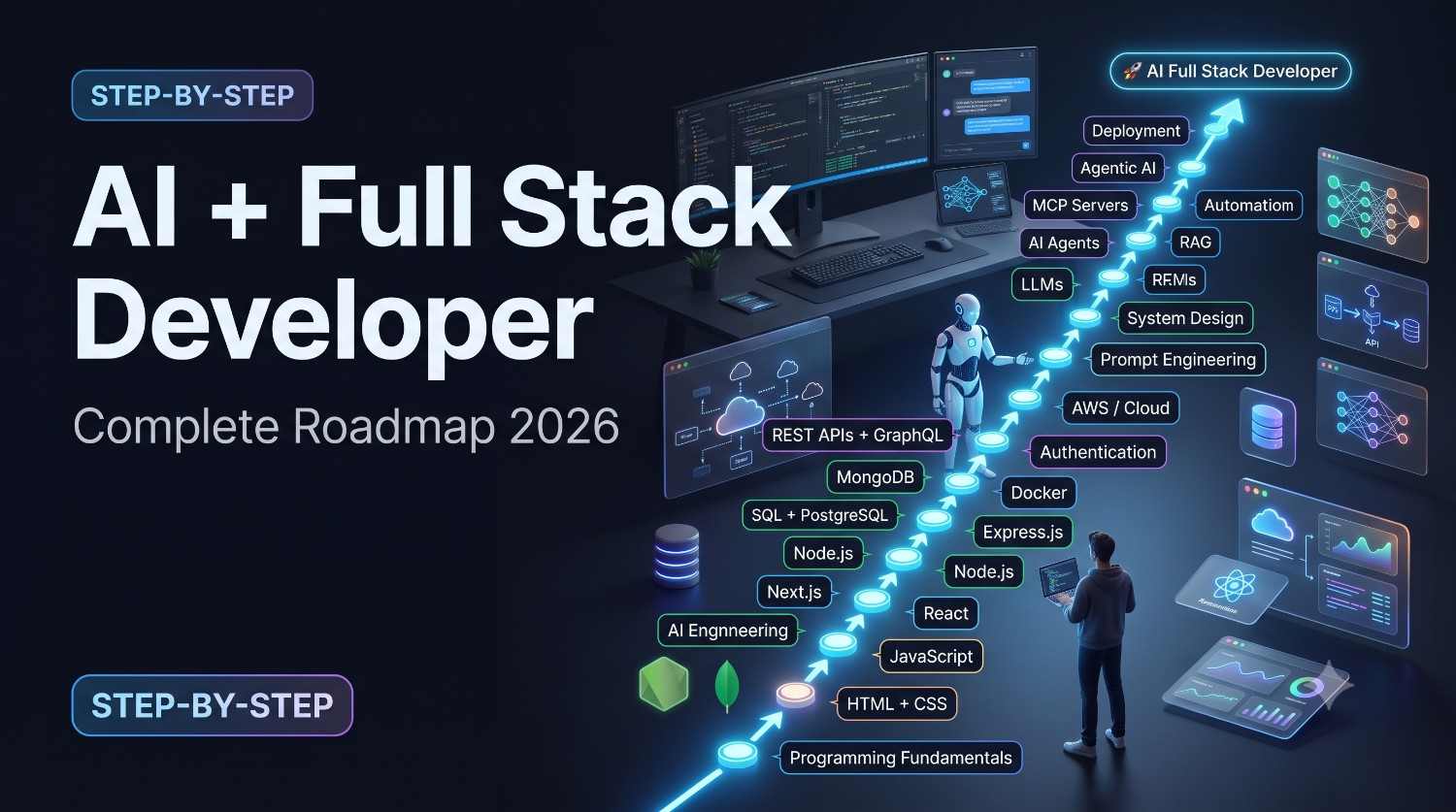
Roadmap to Become an AI + Full Stack Developer in 2026
Discover the ultimate, step-by-step roadmap to becoming an AI-driven Full-Stack Developer in 2026. Master next-gen web frameworks, vector databases, agentic workflows, and modern MLOps to dominate the software engineering landscape.