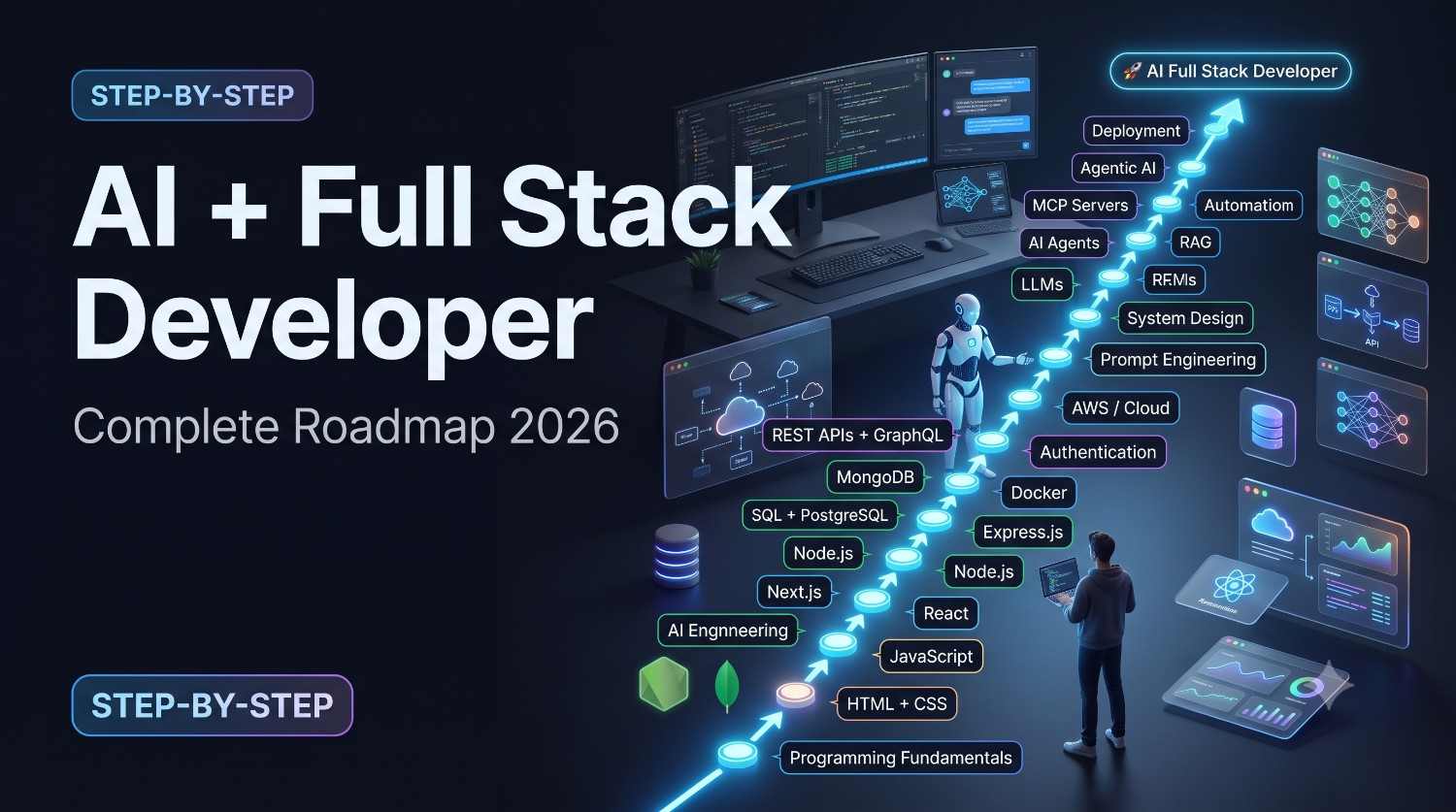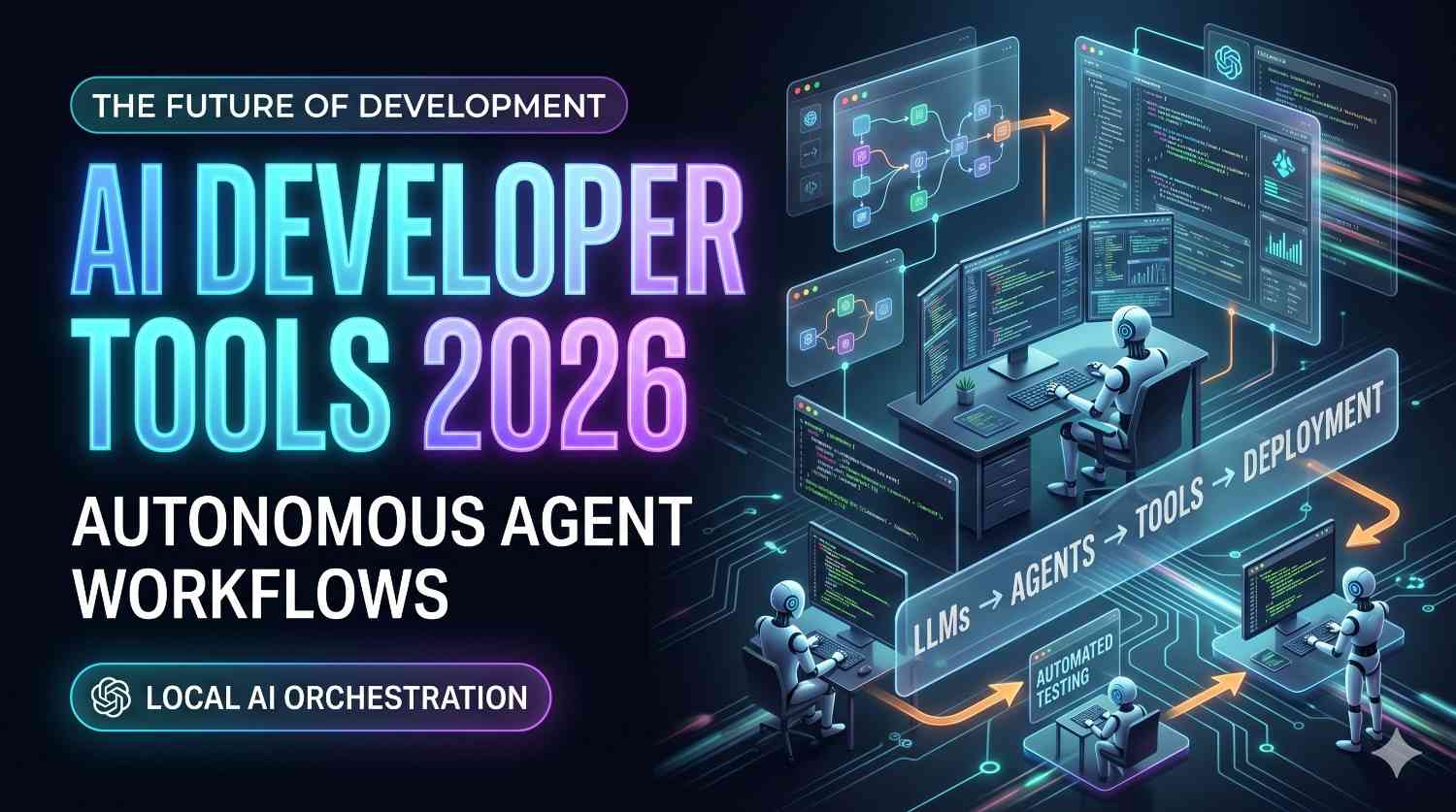
AI Developer Tools Update (May 2026): The Rise of Local Orchestration and Autonomous Agent Workflows
Something fundamentally changed in software engineering during the first half of 2026.
Developers stopped treating AI as a chatbot sitting beside the IDE. Instead, AI became the runtime itself — planning tasks, coordinating tools, managing memory, generating infrastructure, reviewing pull requests, orchestrating deployments, and increasingly operating like an autonomous engineering teammate.
The biggest shift is not just better models. It is the emergence of AI-native development workflows powered by local AI orchestration, autonomous AI agents, and persistent multi-agent systems running directly on developer machines.
What began as autocomplete has evolved into an entirely new software engineering paradigm.
Teams experimenting with Claude Code, OpenAI Codex Agents, Cursor AI, Windsurf, CrewAI, LangGraph, and local LLM workflows are discovering something unsettling: modern AI systems no longer behave like tools.
They behave like infrastructure.
Developers building AI-native stacks are also revisiting foundational engineering concepts such as scalable backend architecture, SOLID engineering principles, and modern Node.js application workflows because AI orchestration systems amplify both good and bad engineering decisions.
Why May 2026 Became a Turning Point for AI Developer Tools
May 2026 is increasingly viewed as the month when the AI tooling ecosystem crossed a threshold from “assistive AI” into “semi-autonomous software production systems.”
Three major industry shifts converged simultaneously:
Local-first AI runtimes matured enough for real engineering workflows
Multi-agent orchestration frameworks stabilized for production environments
Persistent memory architectures transformed AI agents into long-running collaborators
The result is an entirely new AI developer workflow where coding assistants no longer merely suggest code — they execute structured engineering objectives across interconnected systems.
“The IDE is becoming an operating system for autonomous reasoning.”
Developers are increasingly pairing AI-native IDE workflows with Next.js production architectures, scalable vector infrastructure, and local orchestration layers to build fully autonomous engineering pipelines.
What Is Local AI Orchestration?
Local AI orchestration refers to running AI agents, models, memory systems, vector databases, and tool-calling pipelines directly on local hardware instead of relying entirely on cloud APIs.
Think of it as Kubernetes for autonomous intelligence.
Core Components of Local AI Orchestration
Component Purpose Popular Tools Local LLM Runtime Runs AI models locally Ollama, LM Studio Agent Orchestration Coordinates multi-agent workflows LangGraph, CrewAI, AutoGen Memory Layer Persistent contextual storage ChromaDB, Weaviate, Qdrant Tool Calling Enables external actions MCP, OpenAPI agents IDE Integration AI-native coding workflows Cursor, Windsurf, Claude Code
Why Developers Are Moving Toward Local-First AI Systems
Privacy: Sensitive repositories remain local
Latency: Local inference dramatically reduces response times
Offline capability: Autonomous systems continue operating without internet dependency
Cost efficiency: Reduced API usage lowers operational expenses
Customization: Fine-tuned workflows become easier to maintain
# Local AI orchestration stack example

Developer Machine
│
├── Ollama Runtime
│   ├── llama4-coder
│   ├── deepseek-r1
│   └── embedding-model
│
├── LangGraph Orchestrator
│   ├── Planner Agent
│   ├── Coding Agent
│   ├── Reviewer Agent
│   └── Deployment Agent
│
├── Vector Database
│   └── Qdrant
│
├── MCP Tool Layer
│   ├── GitHub Tool
│   ├── Docker Tool
│   ├── PostgreSQL Tool
│   └── Browser Automation
│
└── Cursor IDE Integration
Autonomous AI Agent Workflows Explained
Autonomous AI agents are systems capable of planning, reasoning, executing tasks, evaluating results, and iterating toward goals with limited human supervision.
The critical difference between a chatbot and an autonomous coding agent is persistence.
Modern AI agents maintain:
Long-term memory
Tool awareness
Execution loops
Contextual planning
Task decomposition
Environment state tracking
Multi-Agent Coordination Flow
User Request
      │
      ▼
Planner Agent
      │
      ├── API Design Agent
      ├── Database Agent
      ├── Frontend Agent
      ├── Testing Agent
      └── Security Review Agent
              │
              ▼
        Shared Memory Bus
              │
              ▼
        Deployment Agent
              │
              ▼
         CI/CD Pipeline
This architecture is increasingly common in AI-native engineering environments where developers orchestrate multiple specialized agents rather than relying on one monolithic assistant.
How Agent Memory Systems Work
// Simplified persistent memory architecture

const memory = {
  shortTerm: sessionContext,
  longTerm: vectorDatabase,
  semanticIndex: embeddings,
  executionHistory: taskLogs,
  repoKnowledge: codebaseGraph
};

agent.retrieve(memory);
agent.plan();
agent.execute();
agent.reflect();
agent.storeNewKnowledge();
Major AI Developer Tools Leading the Shift in 2026
Claude Code
Claude Code evolved into one of the most trusted AI engineering environments for large-scale reasoning, repository navigation, architecture analysis, and long-context development.
Developers increasingly use it for:
Refactoring enterprise monoliths
Architecture migration planning
Codebase summarization
Long-horizon debugging workflows
Its strongest capability is contextual reasoning across enormous repositories.
OpenAI Codex Agents
OpenAI’s autonomous coding agents shifted AI development from “completion” to “delegation.”
Teams now assign entire engineering objectives:
Generate microservices
Fix integration issues
Create infrastructure
Implement authentication flows
Write tests and deployment scripts
Cursor AI
Cursor became the center of AI-native software engineering workflows because it merged:
IDE context awareness
Inline AI collaboration
Repository-wide reasoning
Autonomous code actions
Agent execution loops
Developers pairing Cursor with advanced JavaScript engineering patterns and modular backend architectures are building surprisingly resilient AI-assisted systems.
Windsurf
Windsurf focused heavily on flow-state engineering.
Rather than interrupting developers with suggestions, Windsurf agents proactively maintained architectural consistency, tracked implementation objectives, and coordinated edits across repositories.
LangChain & LangGraph
LangGraph became one of the defining orchestration frameworks of 2026.
It solved a critical limitation: deterministic orchestration for non-deterministic models.
# LangGraph multi-agent workflow example

from langgraph.graph import StateGraph

graph = StateGraph()

graph.add_node("planner", planner_agent)
graph.add_node("coder", coding_agent)
graph.add_node("reviewer", review_agent)

graph.add_edge("planner", "coder")
graph.add_edge("coder", "reviewer")

graph.compile()
Continue.dev
Continue.dev accelerated local-first AI coding by enabling developers to integrate custom local models directly into VS Code workflows.
Ollama & LM Studio
Ollama normalized local LLM execution.
Running production-grade models locally is no longer considered experimental — it is rapidly becoming standard engineering infrastructure.
# Running local models with Ollama

ollama run llama4-coder
ollama run deepseek-r1
ollama serve
CrewAI & AutoGen
These frameworks popularized role-based autonomous agent collaboration.
Developers can now construct:
Architect agents
Security agents
QA agents
Infrastructure agents
Research agents
Each agent specializes in a domain while coordinating through shared memory systems.
Local AI vs Cloud AI: The Infrastructure Tradeoff
Category Local AI Workflows Cloud AI Workflows Latency Extremely fast Dependent on API response times Privacy High External dependency Cost Hardware investment Recurring API costs Customization Extensive Limited by provider Scalability Hardware constrained Cloud elastic scaling Offline Capability Fully supported Not possible
Most mature AI engineering teams now operate hybrid workflows:
Local models for coding and memory
Cloud models for reasoning-intensive tasks
Agent orchestration running locally
Selective API escalation for complex planning
Real-World Autonomous AI Developer Workflows
1. AI Agents Building Full-Stack SaaS Applications
A developer defines a product specification.
Autonomous agents then:
Generate backend APIs
Create database schemas
Implement authentication
Build frontend components
Write integration tests
Configure CI/CD pipelines
Deploy staging infrastructure
Goal:
"Build a subscription analytics dashboard"

Planner Agent
    ↓
Frontend Agent → React + Next.js UI
Backend Agent → Node.js APIs
Database Agent → PostgreSQL schema
DevOps Agent → Docker + CI/CD
QA Agent → End-to-end tests
2. Automated Debugging Pipelines
AI debugging agents now monitor:
Logs
Exceptions
CI failures
Performance regressions
Dependency vulnerabilities
The agent reproduces the issue, generates fixes, runs tests, and proposes pull requests automatically.
3. AI-Powered DevOps Automation
AI infrastructure agents increasingly manage:
Kubernetes optimization
Infrastructure provisioning
Observability pipelines
Security patching
Container orchestration
Teams adopting AI DevOps workflows are also investing heavily in Git workflow automation and production-grade deployment standards.
4. AI Documentation Systems
Documentation agents continuously:
Monitor code changes
Update API docs
Generate architecture diagrams
Create onboarding guides
Explain legacy systems
MCP Workflows Are Quietly Reshaping AI Infrastructure
The Model Context Protocol (MCP) became one of the most important infrastructure standards of 2026.
MCP allows AI agents to interact with tools, databases, browsers, terminals, APIs, and external systems using structured interfaces.
{
  "tool": "postgres.query",
  "input": {
    "sql": "SELECT * FROM users LIMIT 10"
  }
}
MCP effectively transformed AI systems into composable operating environments.
Instead of manually wiring integrations, developers now build reusable AI tool ecosystems.
Local AI Infrastructure Requirements in 2026
Typical Local AI Engineering Stack
Infrastructure Layer Recommended Setup GPU RTX 5090 / Apple M4 Ultra / MI400-class hardware Memory 64GB–256GB RAM Local Models Llama 4, DeepSeek, Mistral, Qwen Vector Database Qdrant, ChromaDB, Weaviate Orchestration Runtime LangGraph, CrewAI IDE Cursor, Windsurf, VS Code
The modern developer workstation increasingly resembles a miniature AI datacenter.
Security Risks and Governance Challenges
Autonomous AI systems introduce enormous opportunities — but also significant engineering risks.
Major Risks Developers Face
Autonomous hallucinations creating flawed infrastructure
Unsafe tool execution causing destructive actions
Over-automation reducing human oversight
Credential leakage through agent memory systems
Dependency poisoning in autonomous package installation
Recursive agent failures across orchestration graphs
Common Mistakes Developers Make
Trusting AI-generated infrastructure blindly
Skipping human code reviews
Ignoring prompt versioning
Building agents without memory boundaries
Overloading single-agent architectures
Using production credentials during autonomous execution
AI-native engineering requires stronger operational discipline — not weaker engineering standards.
Best AI Developer Tool Stack in 2026
Recommended AI-Native Workflow Stack
Workflow Layer Recommended Tools IDE Cursor + Claude Code Local Models Ollama + LM Studio Agent Orchestration LangGraph + CrewAI Memory Qdrant + ChromaDB Tool Integration MCP Runtime Deployment Docker + Kubernetes
Developers combining these systems with scalable backend engineering practices and robust PostgreSQL data architectures are building surprisingly autonomous software companies.
The Future of AI-Native Development
The software industry is entering an era where:
AI systems manage engineering operations continuously
Developers supervise orchestration instead of writing every implementation detail
IDEs evolve into autonomous execution environments
Software teams become human-agent collectives
AI memory becomes organizational infrastructure
By 2030, many startups may operate with:
3 human engineers
50 autonomous coding agents
Persistent memory graphs
AI-operated CI/CD systems
Self-healing infrastructure
The future developer is not merely writing software. The future developer is orchestrating intelligence.
Key Takeaways
AI developer tools are evolving into autonomous engineering systems
Local AI orchestration is becoming foundational infrastructure
Autonomous AI agents now coordinate real software workflows
Multi-agent systems outperform monolithic AI assistants
MCP workflows are standardizing AI tool interoperability
Persistent memory systems are transforming agent capabilities
Human oversight remains critical for safety and governance
AI-native development is redefining software engineering itself
Official References & Further Reading
FAQs
What are the biggest AI developer tool trends in May 2026?
The largest trends include local AI orchestration, autonomous coding agents, multi-agent systems, persistent memory architectures, AI-native IDEs, and local-first LLM workflows integrated directly into software engineering pipelines.
What is local AI orchestration?
Local AI orchestration refers to running AI models, memory systems, agent runtimes, vector databases, and tool integrations directly on local hardware rather than depending entirely on cloud APIs.
Why are developers moving toward local-first AI systems?
Developers want lower latency, better privacy, offline capabilities, lower API costs, and greater control over AI workflows.
What are autonomous AI agents?
Autonomous AI agents are systems capable of planning tasks, using tools, maintaining memory, executing workflows, evaluating outputs, and iterating toward goals with minimal supervision.
Which AI developer tools are leading the industry in 2026?
Claude Code, OpenAI Codex Agents, Cursor AI, Windsurf, LangGraph, CrewAI, AutoGen, Ollama, Continue.dev, and OpenDevin are among the most influential platforms.
Are autonomous AI coding agents safe?
They can introduce serious risks including hallucinations, unsafe infrastructure changes, dependency vulnerabilities, and over-automation problems. Human oversight remains essential.
What does AI-native software engineering look like in the future?
Future software engineering workflows will likely revolve around developers orchestrating networks of autonomous agents that manage coding, infrastructure, testing, deployment, observability, and long-term system optimization collaboratively.
The AI developer tools landscape of 2026 no longer resembles traditional software engineering.
We are witnessing the emergence of a new computational layer — one where autonomous agents collaborate with humans, local AI runtimes become standard infrastructure, and software itself increasingly behaves like a living adaptive system.
The next generation of developers will not simply write applications.
They will design ecosystems of intelligence.