Best Platforms for Learning and Practicing SQL in 2026

Software Engineer
- #SQL
- #database
- #Relational database
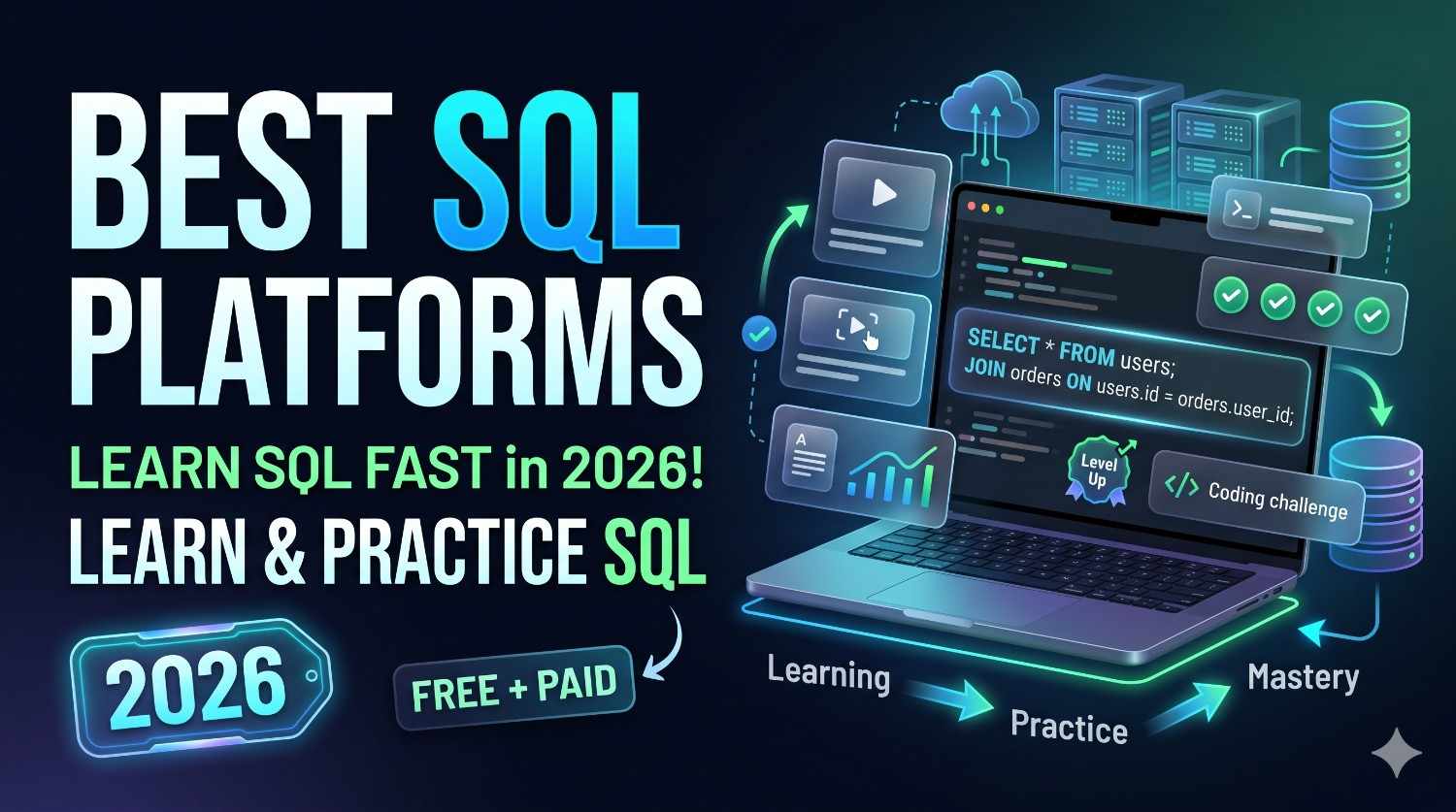
Navigate the 2026 data landscape with our curated list of the top platforms to master SQL. From AI-driven interactive sandboxes to enterprise-level practice environments, find the perfect tool to elevate your data querying skills.
Want to become confident in SQL but confused about where to start? You're not alone. In 2026, SQL is still one of the most valuable skills in tech. Whether you want to become a data analyst, backend developer, full-stack engineer, or database administrator, learning SQL can open countless career opportunities.
But here’s the challenge: there are hundreds of SQL practice websites, tutorials, and coding platforms online. Some are beginner-friendly, while others are focused on interview preparation or advanced real-world scenarios.
So which platforms are actually worth your time?
In this guide, we’ll explore the Best SQL learning platforms in 2026, compare their features, and help you choose the right one based on your goals.
Why Learning SQL Is Important in 2026
SQL (Structured Query Language) is the foundation of modern databases. Almost every application, website, or business system stores data somewhere — and SQL helps developers and analysts interact with that data.
Even with the rise of AI tools and automation, companies still need professionals who can understand data, write optimized queries, and manage databases efficiently.
SQL Skills Are Used In:
Data Analysis
Backend Development
Full-Stack Development
Business Intelligence
Machine Learning Pipelines
Database Administration
Technical Interviews
If you’re learning web development, SQL pairs perfectly with technologies like Node.js, Express, React, and PostgreSQL.
Before diving into SQL practice platforms, it’s helpful to understand Database Fundamentals, Normalization Explained, and concepts like SQL Joins Guide.
What Makes a Good SQL Learning Platform?
Not all SQL coding platforms are designed for the same purpose. Some focus on theory, while others focus on hands-on practice.
A great platform should help you:
Write real SQL queries
Understand database concepts visually
Practice interview-style problems
Work with real-world datasets
Improve query optimization skills
Learn progressively from beginner to advanced
Key Features to Look For
Feature Why It Matters Interactive Editor Helps practice queries directly in browser Real Datasets Improves practical understanding Guided Lessons Useful for beginners Interview Questions Essential for job preparation Progress Tracking Keeps learning structured Community Support Helps solve doubts quickly
Best SQL Learning Platforms in 2026
1. LeetCode
LeetCode is widely known for coding interview preparation, but its SQL section has become incredibly valuable for developers preparing for technical interviews.
The platform contains beginner to advanced SQL interview problems frequently asked by companies like Amazon, Google, and Microsoft.
Best For
SQL interview practice and problem-solving.
Pros
Excellent interview-focused questions
Real company-based problems
Community solutions and discussions
Difficulty levels from easy to hard
Cons
Not ideal for complete beginners
Limited theory explanations
Skill Level
Beginner to Advanced
Free or Paid
Freemium
Real-World Usefulness
Perfect for improving query-writing speed and preparing for coding rounds.
2. HackerRank
HackerRank is one of the best platforms to learn SQL online through structured exercises and guided challenges.
Its SQL domain is beginner-friendly and introduces concepts gradually.
Best For
Beginners and interview preparation.
Pros
Interactive learning experience
Beginner-friendly exercises
Good company preparation content
Clean UI and editor
Cons
Some advanced problems are limited
Less focus on database optimization
Skill Level
Beginner to Intermediate
Free or Paid
Mostly Free
3. SQLBolt
SQLBolt is one of the easiest ways to start learning SQL. It combines lessons with interactive exercises in a very beginner-friendly format.
If SQL syntax feels overwhelming initially, SQLBolt simplifies it beautifully.
Best For
Absolute beginners.
Pros
Simple explanations
Visual learning style
Interactive exercises after every lesson
No signup required
Cons
Limited advanced content
Not interview-focused
Skill Level
Beginner
Free or Paid
Free
4. DataCamp
DataCamp is extremely popular among aspiring data analysts and data scientists. It offers structured SQL courses with hands-on exercises.
The platform focuses heavily on practical data manipulation and analysis.
Best For
Data analysis and career-focused learning.
Pros
Structured learning paths
Hands-on coding exercises
Career-oriented tracks
Real datasets
Cons
Premium subscription required for full access
Can feel slow for experienced developers
Skill Level
Beginner to Intermediate
Free or Paid
Freemium
5. Mode Analytics SQL Tutorial
Mode Analytics provides one of the most practical SQL tutorials available online. It focuses on analytics workflows used in real companies.
Best For
Analytics-focused SQL learning.
Pros
Real business datasets
Practical query examples
Excellent analytics scenarios
Modern learning approach
Cons
Less beginner-friendly
Limited interview-focused practice
Skill Level
Intermediate
Free or Paid
Free
6. Codecademy
Codecademy remains one of the most beginner-friendly coding education platforms. Its SQL courses include guided lessons and quizzes.
Best For
Structured beginner learning.
Pros
Step-by-step lessons
Interactive exercises
Easy-to-follow UI
Career paths available
Cons
Limited advanced SQL depth
Subscription needed for full content
Skill Level
Beginner
7. W3Schools SQL
W3Schools is still one of the fastest resources for quick SQL learning and revision.
It’s especially useful when you want to quickly check syntax or understand a concept.
Best For
Quick learning and revision.
Pros
Easy explanations
Instant examples
Simple online editor
Completely free
Cons
Limited real-world projects
Less depth compared to premium platforms
8. StrataScratch
StrataScratch is one of the best SQL practice websites for advanced interview preparation.
It contains real interview questions from top tech companies and focuses heavily on analytics and business problems.
Best For
Advanced interview preparation.
Pros
Real interview datasets
Strong analytics focus
High-quality company questions
Practical business scenarios
Cons
Can feel difficult for beginners
Premium access required for full features
9. PostgreSQL Exercises
PostgreSQL Exercises is a practical platform focused entirely on hands-on PostgreSQL practice.
Best For
Practical PostgreSQL query practice.
Pros
Focused PostgreSQL exercises
Real query writing
Advanced SQL concepts included
Good for backend developers
Cons
Minimal visual learning
Not ideal for total beginners
10. Interview Query
Interview Query is designed for analytics and data-focused technical interviews. It combines SQL with business analysis questions.
Best For
Data analyst interview preparation.
Pros
Strong analytics-focused questions
Real company interview examples
Detailed explanations
Good structured preparation
Cons
Advanced for beginners
Premium content restrictions
Platform Comparison Table
Platform Best For Skill Level Free/Paid LeetCode Interview Preparation Intermediate to Advanced Freemium HackerRank Beginner Practice Beginner to Intermediate Mostly Free SQLBolt Learning Basics Beginner Free DataCamp Career Learning Beginner to Intermediate Freemium Mode Analytics Data Analytics Intermediate Free StrataScratch Advanced Interviews Intermediate to Advanced Freemium
Step-by-Step SQL Learning Roadmap
Start with SQL basics using SQLBolt or W3Schools.
Learn SELECT, WHERE, ORDER BY, GROUP BY, and JOINS.
Practice basic queries daily on HackerRank.
Study database concepts and normalization.
Move to intermediate SQL using PostgreSQL Exercises.
Solve interview problems on LeetCode and StrataScratch.
Build real projects using PostgreSQL or MySQL.
Learn query optimization and indexing.
Example SQL Query Practice
Here’s a simple example beginners often practice:
SELECT name, salary
FROM employees
WHERE salary > 50000
ORDER BY salary DESC;
This query retrieves employees earning more than 50,000 and sorts them by highest salary first.
As you progress, platforms like LeetCode and StrataScratch introduce complex joins, subqueries, window functions, and optimization scenarios.
Real-World Use Cases
Many beginners wonder: “Will practicing SQL actually help in real jobs?”
The answer is absolutely yes.
1. Data Analysis Jobs
Data analysts use SQL daily to extract business insights from massive datasets. Platforms like Mode Analytics and DataCamp simulate these workflows effectively.
2. Backend Development
Backend developers use SQL databases like PostgreSQL and MySQL to store user accounts, products, orders, and transactions.
Real SQL practice helps developers write optimized queries inside APIs.
3. Full-Stack Development
Full-stack developers often combine React, Node.js, Express, and PostgreSQL. SQL knowledge becomes essential for building scalable applications.
4. Database Administration
Database administrators monitor performance, manage backups, and optimize database structures using advanced SQL.
5. Technical Interviews
Many companies include SQL rounds during interviews. Platforms like LeetCode and Interview Query prepare candidates for real interview scenarios.
6. Real Company Projects
E-commerce systems, banking applications, social media platforms, and analytics dashboards all rely heavily on SQL databases.
Strong SQL skills directly improve your ability to work on production systems.
Official Documentation Resources
Along with practice platforms, reading official documentation helps you understand SQL deeply and accurately.
Best Platform Recommendations
Best for Beginners
SQLBolt
W3Schools SQL
Codecademy
Best for Interview Preparation
LeetCode
HackerRank
StrataScratch
Best for Real-World Projects
Mode Analytics
DataCamp
PostgreSQL Exercises
Best for Advanced Learners
Interview Query
LeetCode
PostgreSQL Exercises
Free vs Paid SQL Platforms
Platform Type Advantages Limitations Free Platforms Accessible, beginner-friendly, good for fundamentals Limited advanced content Paid Platforms Structured paths, projects, certifications Subscription costs
Key Takeaways
SQL remains one of the most important technical skills in 2026.
Beginners should start with simple interactive platforms like SQLBolt.
HackerRank and LeetCode are excellent for SQL interview practice.
DataCamp and Mode Analytics provide strong real-world learning experiences.
Practicing consistently is more important than learning theory alone.
Combining SQL with real projects accelerates career growth significantly.
Conclusion
Choosing the right SQL platform depends entirely on your goals.
If you're a beginner, focus on learning the fundamentals through interactive lessons. If you're preparing for interviews, challenge yourself with real company problems. And if you want to work on production-grade applications, prioritize platforms that expose you to real-world datasets and practical workflows.
The good news is that you don’t need to master everything at once.
Start small. Practice consistently. Build projects. Solve problems daily.
SQL is one of those skills that compounds over time — and the sooner you start, the more opportunities you create for yourself.
FAQs
Which is the best SQL platform for beginners?
SQLBolt and W3Schools are excellent for beginners because they provide simple explanations and interactive examples.
Which SQL platform is best for interview preparation?
LeetCode, HackerRank, and StrataScratch are among the best platforms for SQL interview practice.
Can I learn SQL for free online?
Yes. Many platforms like SQLBolt, HackerRank, W3Schools, and Mode Analytics provide free SQL learning resources.
How long does it take to learn SQL?
Most beginners can learn basic SQL within a few weeks of consistent practice. Advanced query optimization and analytics skills may take several months.
Is SQL enough to get a job?
SQL alone can help in entry-level data and analytics roles, but combining it with Python, Excel, Power BI, or backend development skills significantly improves job opportunities.
Which SQL database should beginners learn first?
PostgreSQL and MySQL are excellent starting points because they are widely used, beginner-friendly, and supported by extensive documentation.